
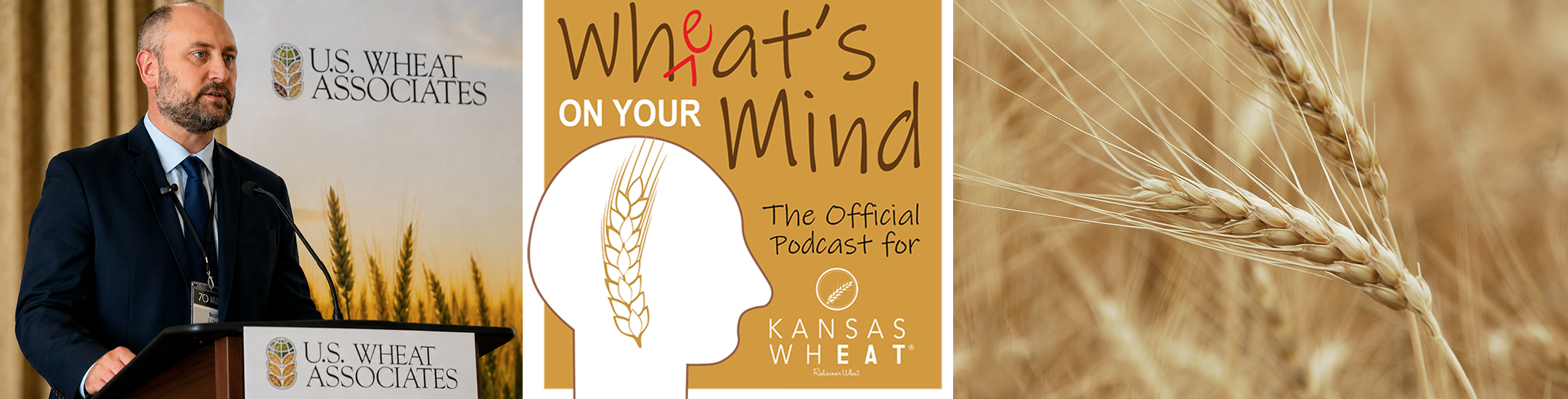
After a strong marketing year for U.S. wheat exports in his first year as vice president of overseas operations at U.S. Wheat Associates (USW), Brian Liedl is focused on customer retention and opportunities for growth.
Liedl recently joined Kansas Wheat CEO Justin Gilpin and host Aaron Harries on the “Wheat’s On Your Mind?” podcast to discuss his first year at USW, the impact of a strong 2025/2026 marketing year and the opportunities and challenges shaping the outlook for U.S. wheat producers and their overseas customers.
Liedl joined USW on July 1, 2025, bringing more than two decades of experience in wheat merchandising, logistics and international grain trading. His first year coincided with strong export demand supported by a large, high-quality U.S. wheat crop and competitive prices.
“The hard work was done by the growers,” Liedl said. “They produced a great crop with big bushels and good quality. High production led to attractive prices, and many decades of market development meant we were in the right place at the right time to capitalize on that opportunity. It was a great first year to be here.”
The challenge now, Liedl shared, is to move the conversation beyond price and focus on converting buyers attracted by competitive prices into consistent, loyal customers.
Supporting Customers in Key Markets
During the episode, the trio reviewed the 2025/2026 marketing year and discussed the outlook for key markets for Kansas and the U.S. Southern Plains.
Mexico was the leading destination for U.S. wheat and a key market across hard red winter (HRW), soft red winter (SRW) and hard red spring (HRS), with HRW sales up more than 40 percent year over year.
“We’ve got some work ahead of us in Mexico,” Liedl said. “It’s a market we invest a lot of resources in, and it’s been a good return on investment so far. USW’s focus is supporting the customers in Mexico, making sure they’re getting the value and technical support they need, and we’ll make sure that we support our side of the negotiations as best we can.”
Nigeria, he said, is a different story. It was a major U.S. wheat market for many years until Black Sea exports became more price-competitive 15 years ago. However, Liedl shared that inroads are being made, and Nigeria is a growing market where quality is becoming a greater factor, and milling companies aim to ensure their flour brands are as good as anywhere in the world.
“We see the growth opportunities going forward, and we are focused on how we can convert those price buyers to quality buyers in a higher-priced year,” Liedl said. “We faced stiff competition last year. You had record crops in places like Argentina and near-record crops in the Black Sea. So even in that highly competitive environment, we were able to gain market share, and hopefully we can hang on to that this year. But that’s going to be our job for the next 12 months.”
USW is also focused on retaining and expanding demand in growing Southeast Asian markets. Liedl pointed to close relationships with millers in the Philippines, where years of technical support and a taste for U.S. wheat have helped growers establish a valuable position that cannot easily be replaced.
Moving the Conversation Beyond Price
While Liedl agreed that price remains central in conversations and decisions for both U.S. wheat customers and growers, he explained that USW remains committed to shifting discussions from price to ‘how can we support you and make sure you’re getting a better margin, not just a lower price?’
“We’re trying our best to make sure that these customers keep their eye on the long game and that they’re building a better product and building loyalty with their customers,” Liedl said. “So no matter what the price of a bushel of wheat does, their customers are going to come with them because the product is better.”
That commitment and work define USW and have become even more important when U.S. wheat is not the lowest-priced option.
“Every market I visit tells the same story. Customers value our quality, USW’s service, technical support and assistance to their bakers and end-use customers,” Liedl said. “It’s a testament to all the work that’s been done over the years that USW has a strong reputation in markets around the world. They were eager when they were able to get very attractive prices, and the questions we’re fielding now are: How can we continue to get this product, even with higher prices? How can we extract that value? That’s what we’re shifting into this year with our work.”
The conversation also delved into supply and demand and why, despite intense competition from Russia and other exporters, Liedl said, the strength of global wheat demand deserves more attention.
“We tend to focus on competition and additional production in the Black Sea region and elsewhere, but the world has absorbed those supplies,” Liedl said. “That competition is also a symptom of having a world that wants more wheat.”
He added that wheat has an important story to tell, as the world’s number one calorie source and a source of carbohydrates, protein and fiber.
“The world will continue to want more of it, and our job at USW is to find ways for U.S. wheat to help meet that demand,” he said.
Looking at 2026 U.S. wheat production and the 2026/2027 marketing year, Liedl also commented that while HRW wheat production will be far less than the previous year, the value proposition to customers remains the same.
“HRW out of the U.S. Southern Plains is still going to stack up great in the global matrix. It’s a high-quality wheat with good protein, low in moisture and has great milling and baking characteristics,” Liedl said. “The world understands that there are cheaper alternatives, but that’s going to cost you something on your end when it comes to a lower input cost but a lower quality product. Everything I hear from customers around the world is that their customers are demanding higher quality and better end-use characteristics. We’re doing a great job producing good wheat, and we just need to make sure our customers see that value.”
A Rewarding Start
Since joining USW, Liedl has prioritized traveling to the organization’s overseas offices, meeting local staff and reviewing how producer resources are deployed across global markets. Ultimately, Liedl shared that his first year at USW has been busy but even more rewarding.
“One thing I always really loved about working with USW [in his previous role] was how well they interact with the customers and seeing the respect for USW’s foreign offices. That’s really what gave me the motivation to make this change,” Liedl said. “It’s been a whirlwind. We have 13 offices around the world, and when I got the position, I said, these are the staff that I’m going to be working with. I want to make sure they meet me in person, that we have an opportunity to connect and review strategy and make sure we’re deploying our resources in the right way.”
Listen to the full episode of “Wheat’s On Your Mind” at wheatsonyourmind.com.