

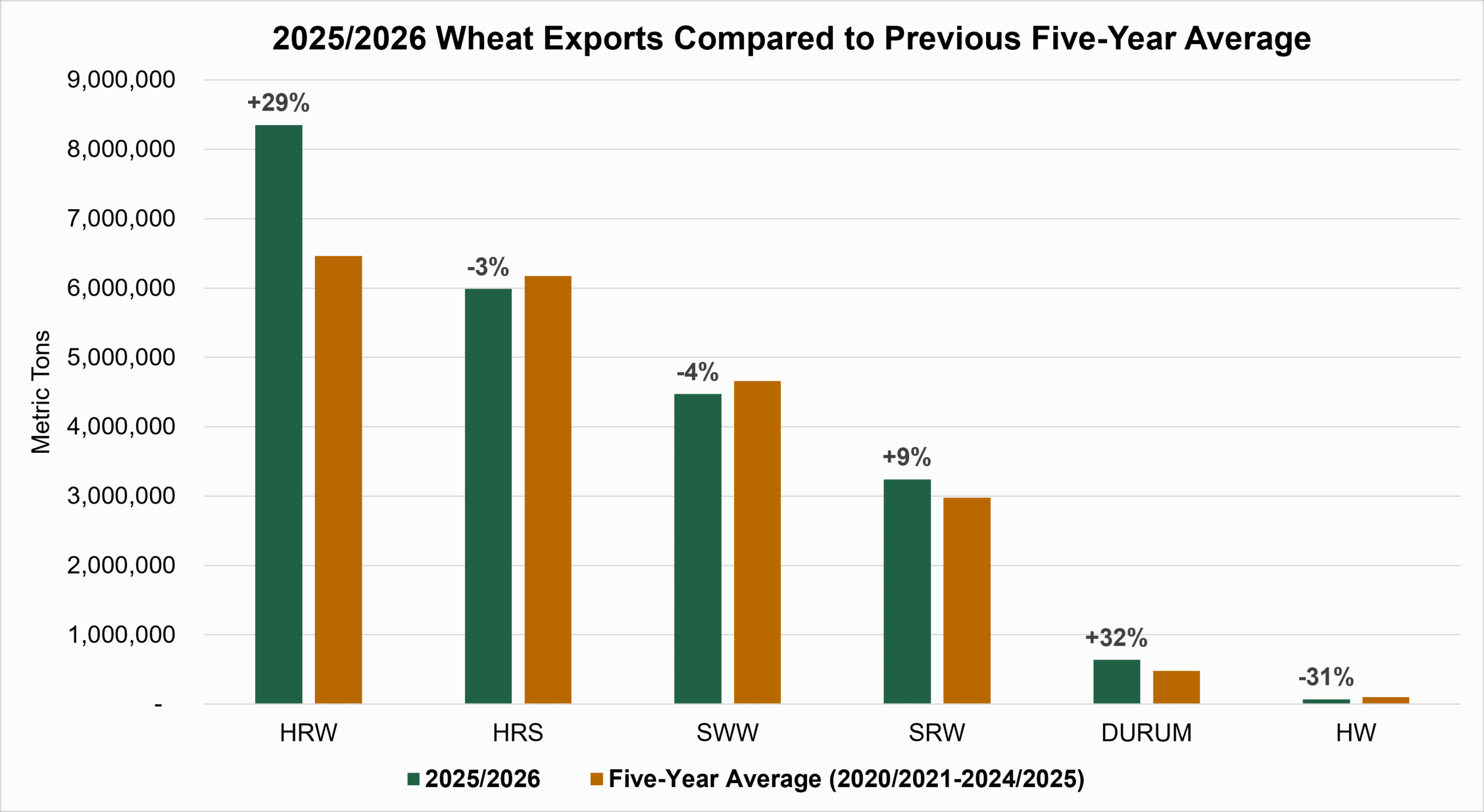
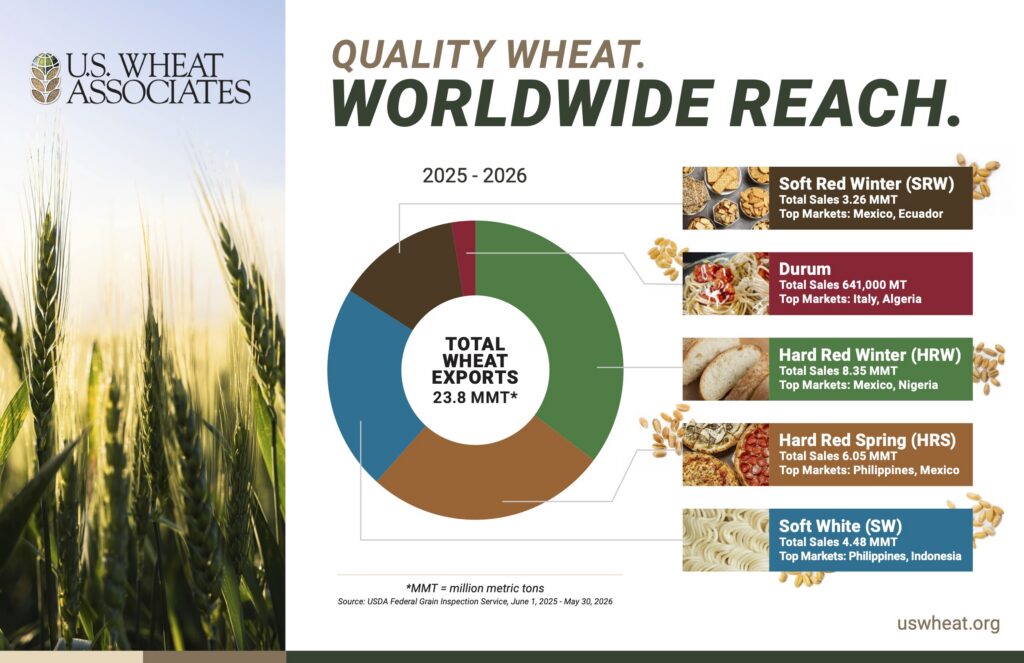
The 2025/2026 marketing year closed on May 31, 2026, and U.S. wheat export sales finished the year on a strong note, providing a buffer of support for farm families during a year of low farmgate prices. Final export inspections hit 23.8 million metric tons (MMT) or 871 million bushels, representing a nearly 15% increase year-over-year and the highest exports since the 2020/2021 marketing year.
The volume is impressive, but the numbers alone do not tell the full story. Just as important as how much wheat was sold was where those sales originated. Increases in wheat exports to both core and swing markets reflect the reputation and value of U.S. wheat in the global marketplace.
“U.S. wheat continued to move steadily into global markets despite a year marked by geopolitical uncertainty, volatile freight costs and intense competition from other exporting origins,” said Brian Liedl, USW vice president of overseas operations. “In a year where there were record or near-record crops in almost every major wheat exporting country, U.S. wheat found its place in the market.”
A Balanced Year
The mix of sales to both core and swing markets in the 2025/2026 marketing year reflects the resilience of the U.S. wheat export program. At the beginning of the year, the USDA projected exports at 21.8 MMT (801 million bushels) and revised that estimate several times as commercial sales continued to outpace the prior year.
By the end of the year, more than 55 countries had purchased U.S. wheat, reflecting strong early-season demand and continued sales to a mix of core, emerging and swing markets.
“What made this marketing year notable is that both core and swing markets performed well at the same time,” Liedl said. “Core markets continued to purchase through the second half of the marketing year when U.S. prices appreciated significantly and kept our supply chains moving. At the same time, several re-emerging and price-sensitive markets increased purchases. That is not a coincidence; it is a return on investment that plays out slowly and then all at once.”
As the primary core destination for U.S. wheat, Mexico once again ranked as the top market in 2025/2026, the largest buyer of U.S. hard red winter (HRW) and U.S. soft red winter (SRW) and the second-largest buyer of U.S. hard red spring (HRS). In total, Mexico purchased 41.6 MMT (nearly 153 million bushels) of U.S. wheat, a 3% increase year-over-year.
Strong sales to Japan, the Philippines and South Korea further reinforced the importance of continued trading servicing in these core markets.
Rounding out the top buyers of U.S. wheat were swing markets Nigeria and Indonesia, both of which had purchases that significantly exceeded their five-year averages.
In Nigeria, U.S. wheat sales expanded sharply in the 2025/2026 marketing year, hitting 1.65 MMT (60.7 million bushels) – more than double the prior year. This pace was sustained despite strong world supplies and cheaper alternative origins – often at a 15 to 25% discount – in the latter half of the marketing year. While still below export levels from 15 years ago, continued purchases throughout the marketing year underscore the country’s role as an opportunistic destination for quality U.S. wheat amid shifting West African sourcing patterns and strong milling demand.
Indonesia has been a key driver of sales strength in Southeast Asia in the 2025/2026 marketing year, which is notable, as this price-sensitive market can swing greatly from year to year. Indonesia ended the marketing year with 1.15 MMT (42.4 million bushels) in U.S. wheat purchases, a 50% increase year-over-year. This year’s sales are underpinned by the July MOU signing between U.S. Wheat and APTINDO, Indonesia’s flour milling association. This marketing year’s sales meet that purchase commitment and signal a notable rebound in U.S. export potential within one of the world’s largest wheat markets.
Looking Forward to 2026/2027
Overall, the 2025/2026 marketing year underscored the value of U.S. wheat in an increasingly crowded and complex global marketplace. Despite increases in global production and geopolitical pressures, customers continued to rely on U.S. wheat exports to meet their growing needs.
“The 2025/2026 marketing year serves as a reminder that even in a competitive and uncertain environment, American wheat farmers, supported by U.S. wheat, are finding opportunities to grow exports and deliver value across the world,” said Luke Muller, USW market analyst. “Maintaining this momentum will depend on continuing to strengthen trade relationships in both core and emerging markets and continuing to adapt to shifting global supply dynamics.”
As the calendar flips to June, the USDA has already reported more than 3.0 MMT (110 million bushels) of sales for the 2026/2027 marketing year. All eyes are currently on the progress of the 2026 wheat crop as the combines have started cutting in the southern United States. As harvest progresses, U.S. Wheat will continue its work to position producers to take advantage of market opportunities with the right mix of customers, in the right places, at the right time.