
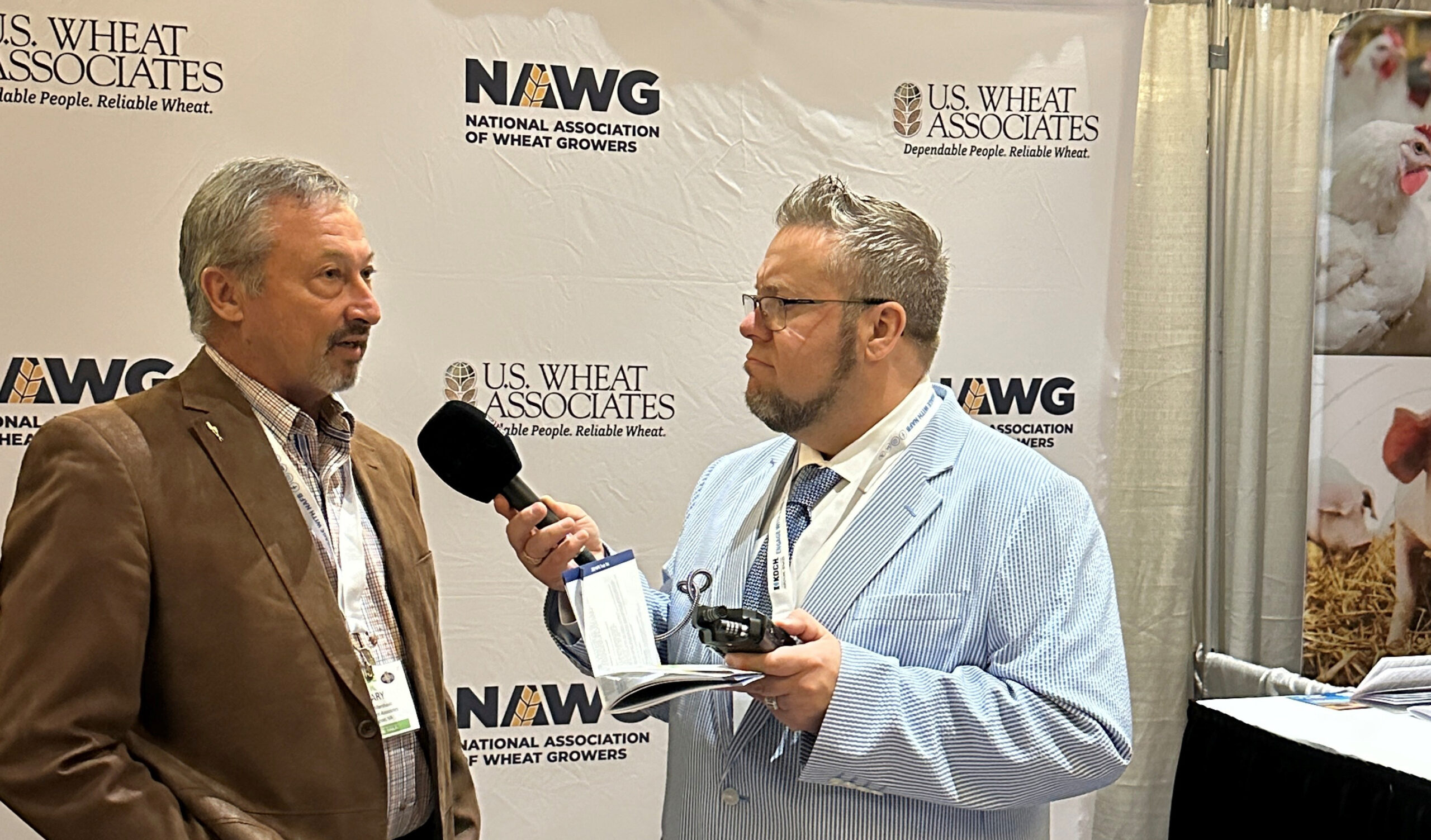
It was raining questions inside the U.S. wheat industry’s booth this year at Trade Talk, hosted by the National Association of Farm Broadcasters (NAFB). That’s hardly by coincidence as a fair share of the questions happened to be about rain.
“When you want to strike up a conversation with a farmer, weather is a pretty good place to start,” acknowledged Gary Millershaski, vice chair of U.S. Wheat Associates (USW) and Kansas wheat farmer.
Millershaski was a beacon for wheat during this year’s Trade Talk, conducted Nov. 20 in Kansas City. An annual event during NAFB’s national convention, the day-long event connects farmers and agriculture organizations with broadcasters for discussions on current issues and topics. At Trade Talk 2025, USW and the National Association of Wheat Growers (NAWG) partnered to host a U.S. wheat industry booth, where NAFB members stopped by to conduct radio and podcast interviews.
Along with Millershaski, Ralph Loos, USW director of communications and global outreach, and Elizabeth Rivera, NAWG’s director of communications and partnerships, were on hand to field questions on everything from the 2025 wheat harvest to the newly-planted winter wheat crop to international trade to Farm Bill possibilities to, of course, the impact of weather – specially rain, or lack thereof.
Millershaski was asked many times about conditions for his winter wheat crop, which he called, “one of the best wheat plantings in six or seven years.”
Because of his role on the USW Board of Directors, Millershaski took questions about customers of U.S. wheat around the world. He shared what he has learned while traveling to export markets with USW in recent years, noting how the quality of U.S. wheat and the reliability of the U.S. wheat supply stand out.
“When I am on those trips visiting mills and bakeries and talking to the people who import the six classes of U.S. wheat, I see how USW staff round the world build relationships and work on behalf of wheat farmers,” Millershaski said. “I always think, ‘I wish I could share this story with people back home.’ Trade Talk was the opportunity to do that, to share those stories about what we do to.”
NAFB estimated that 120 broadcasters conducted more than 2,500 interviews at this year’s Trade Talk. Representatives of the corn, soybean, sorghum, fertilizer, seed and livestock industries joined the U.S. wheat industry on the event floor.
“There are few opportunities that allow us to engage such a large swath of the ag media all in one place at one time and reach such a broad audience,” Loos said. “Trade Talk lets us share our messages and it lets us update broadcasters – and their audiences – on what’s going on in the U.S. wheat industry, both at home in our farmers’ fields and in the global wheat marketplace.”