
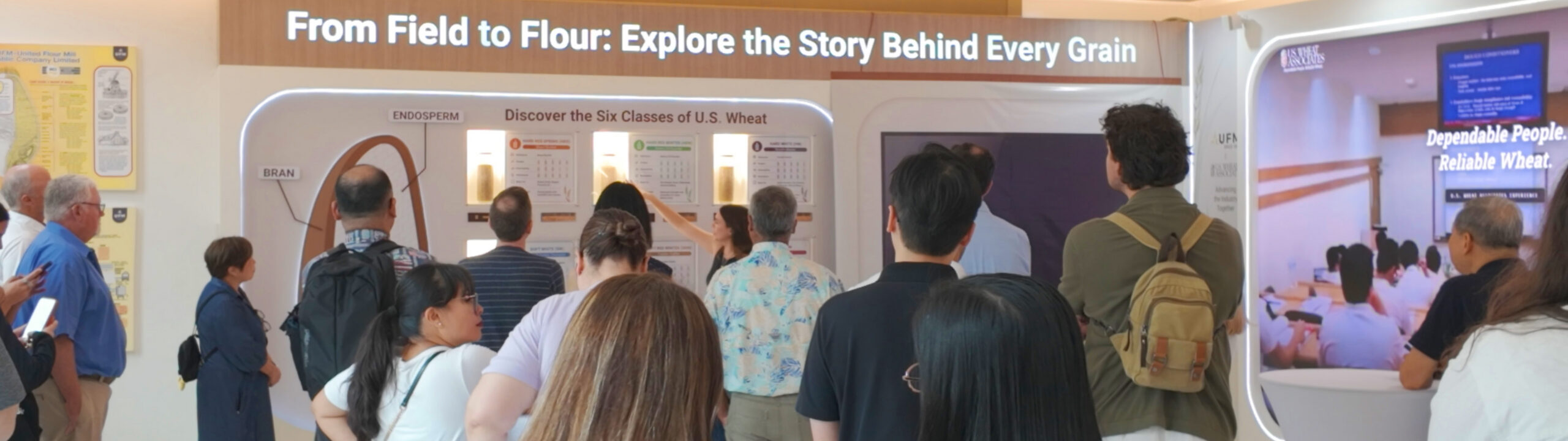
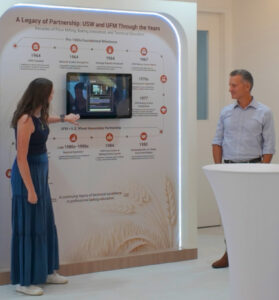
A large interactive display at Thailand’s UFM Baking School will connect a new generation of Southeast Asian flour millers and bakers with the quality, versatility and performance of U.S. wheat.
Designed and built by U.S. Wheat Associates (USW), the expansive, technology-driven installation does more than serve as a showcase. It tells the story of a relationship built over nearly 50 years — one that has helped introduce generations of millers and bakers to the advantages of using U.S. wheat.
“It’s impressive both in size and in its capabilities,” said Joe Sowers, USW Vice President for South and Southeast Asia. “The display combines educational videos, interactive games, information about wheat classes and a photographic look back at the students who have participated in training programs over the decades.”
The goal is straightforward: help the next generation of industry professionals understand how different classes of U.S. wheat perform, which products they best serve and why U.S. wheat remains a valuable ingredient for milling and baking operations throughout the region.
The UFM Baking School itself is unique in that it trains industrial bakers and millers from around Southeast Asia. An estimated 500 to 700 students annually attend extended training programs, providing USW with a steady audience of industry professionals who take what they learn back to their businesses, training colleagues and junior staff, and influencing the market in their regions.
USW has had a collaboration with the school since 1980.
“The students actually fund themselves to come to this facility to learn from U.S. Wheat technicians how to use our products,” Sowers said. “It’s been an amazing, effective tool.”
He added that technical training has played an important role in building demand for U.S. wheat by allowing millers and bakers to evaluate its performance firsthand.
“We have this very effective training tool showing people how to use our wheat and giving USW the opportunity to convincethem that our wheat classes perform better and offer more value than anybody else’s,” Sowers explained.
An interactive classroom beyond the classroom
The display wall project took shape as United Flour Mills, which funds and operates the UFM Baking School, invested in a largescale building renovation, upgrading its facilities and infrastructure. The company invited USW to contribute a space celebrating their longstanding partnership and educating visitors about U.S. wheat.
Funding available through the America First Trade Promotion Program (AFTPP) program helped make the project possible.
“We see it as a new opportunity to engage not only current customers of U.S. wheat, but future customers as well,” said Tyllor Ledford, USW Assistant Regional Director in South Asia. “This technology gives us a unique and innovative way to educate people about U.S. wheat quality, and it’s something we can use at other trade shows and customer events.”
Ledford, who is based in USW’s Manila Office, played a huge role in development of the display wall.
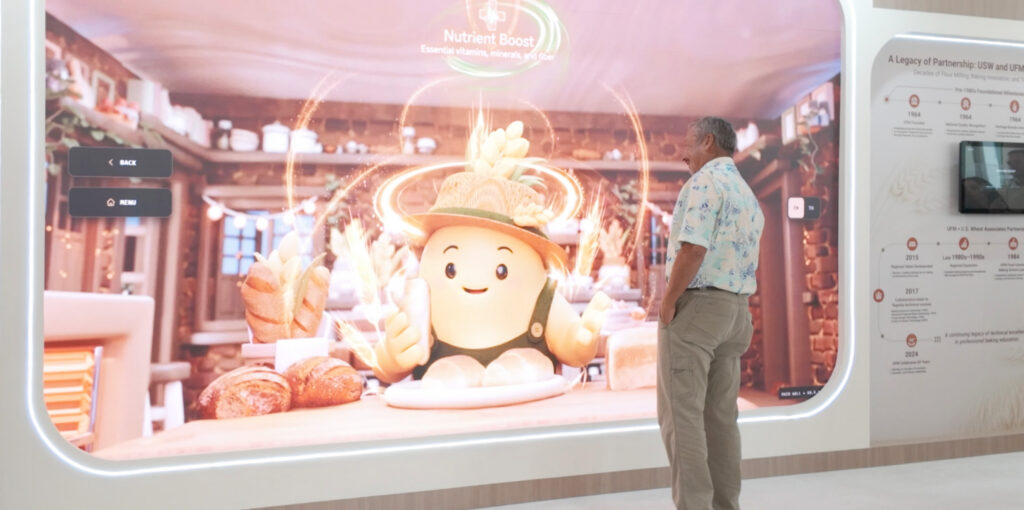
“The quiz game is a fun, interactive way to share information and reach a new audience,” she said. “And then you have Wheatley, who makes it more fun and engaging while giving us a cute, lovable mascot we can build into our marketing campaigns.”
“Wheatley” is a mascot developed by USW. The figure stars in his own video explaining the journey of U.S. wheat from field to flour mill.
USW worked with UFM, technical specialists and a third-party consultant to develop the installation, drawing inspiration from similar educational and museum-style displays observed at milling facilities in Japan and South Korea.
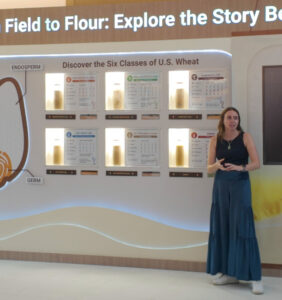
The resulting wall measures six meters (20 feet) wide by three meters (10 feet) high and incorporates several distinct educational elements.
Approximately one-quarter of the display focuses on U.S. wheat and its six classes, explaining their characteristics and uses. A collection of marketing videos introduce visitors to U.S. wheat production and the broader value of the U.S. wheat supply chain, along with the role of USW in providing information to customer of U.S. wheat.
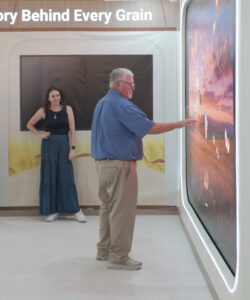
An interactive quiz and game put students’ knowledge to the test, covering the different wheat classes, how wheat is grown and how specific classes translate into flour and finished baked goods.
Students can explore which types of wheat are best suited to particular applications, connecting the characteristics of the grain to the practical demands of commercial baking and milling.
That information matters in an industry where flour performance can influence product quality, processing efficiency and the consistency of finished goods.
The display also highlights the human side of the partnership. A digital, yearbook-style feature showcases past students and their experiences with USW training programs.
Photographs have long been a popular feature at the school, with visitors often stopping to identify colleagues, friends and former classmates. The new installation builds on that interest by making the historical record more interactive and creating opportunities to incorporate images from courses and training activities.
For Sowers, that element reinforces the enduring value of the relationship.
“It is really passing along that legacy of relationship with this industry for the past five decades,” he said.
Technology built for the future
One of the most important features of the display is its ability to evolve.
Rather than relying on static panels that become outdated as information changes, the system uses modern digital technology that allows USW staff to update content remotely from headquarters.
That flexibility means the wall can reflect changing market conditions, new crop information, emerging product applications and upcoming technical courses.
For example, a course focused on cookies and crackers could feature information about soft white wheat or soft red winter wheat, two classes used in a range of baked products. Updates can be made as new information becomes available or as USW identifies particular messages it wants to emphasize.
The ability to refresh the content also helps the display remain relevant to returning students and industry visitors.
“The technology was the most important thing — that we have something that can grow into the future,” Sowers said. “It’s something that we can update.”
The concept emerged through a collaborative process involving USW staff and technical experts, with the team balancing educational objectives, design considerations and long-term functionality.
The result is intended to be more than a permanent promotional installation. It is a flexible communications and training resource that can continue to support USW’s work as markets, products and industry needs change.
A strategic location for U.S. wheat
Bangkok is an important setting for the project, placing the display at a training center that serves professionals from across Southeast Asia.
Thailand is a top-ten market for US wheat, and the school has consistent access to US hard red winter (HRW), hard red spring (HRS), soft white (SW), and western white (WW) wheat.
The school’s location in Bangkok, near hotels and other business destinations, also makes it a convenient stop for visiting industry representatives and U.S. agricultural delegations.
Sowers expects the display to become an attraction for visiting U.S. farmers, state wheat commission representatives, USW board members and other groups interested in seeing how the organization promotes U.S. wheat overseas.
“The wall may be a new addition to the school, but its message is rooted in more than five decades of collaboration,” he said. “With its interactive features, remotely updated content and growing digital archive of students and training programs, the installation is designed to keep delivering that message for years, really decades, to come.”