
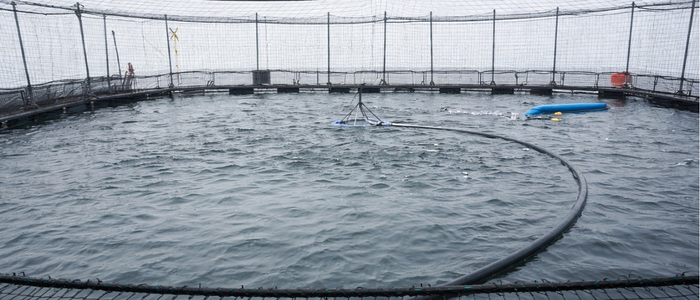
Salmon swimming in a floating net pen in the cool waters of southern Chile may seem about as far away from a planted wheat field in eastern Washington as possible – geographically and visually. But, a recent trade team organized by U.S. Wheat Associates (USW) aimed to strengthen the connection between U.S. farmers and explore an innovative area of growth for wheat exports: South American salmon and shrimp producers.
“U.S. Wheat is partnering with the aquaculture feed industry in South America because we have identified a growing and technically-driven demand for U.S. wheat in addition to our traditional milling markets,” said Miguel Galdos, USW regional director for South America, who is based in Santiago, Chile. “In this industry, wheat is a specialized ingredient in a high-value feed formulation. Feed manufacturers will pay a premium for the right specifications, consistency and performance, which aligns strongly with the strengths of U.S. wheat production and quality assurance systems.”
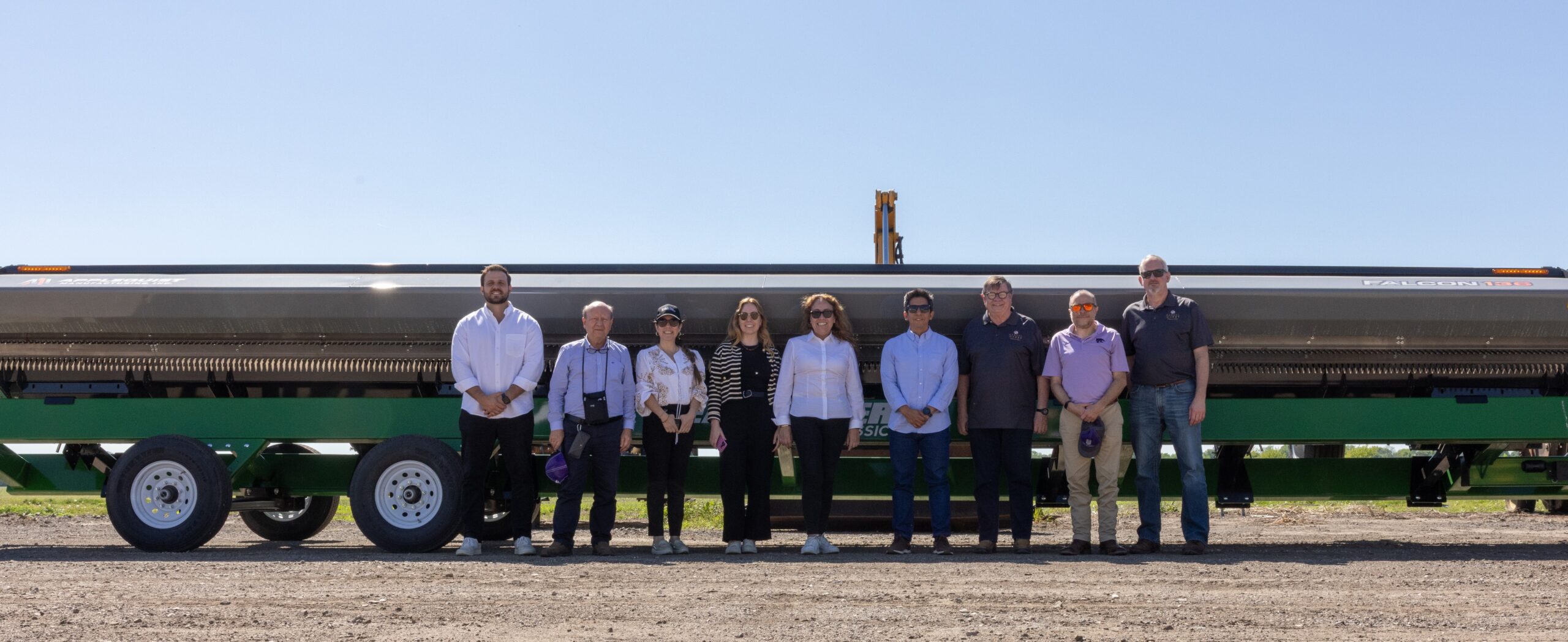
With the goal of engaging key decision-makers and providing a solid understanding of the U.S. wheat supply chain, U.S. Wheat organized a team of procurement directors and managers and researchers representing the salmon industry in Chile and the shrimp industry in Ecuador to travel to Washington, Alabama and Kansas in mid-April. The team met with universities and research centers focused on wheat breeding, extrusion and animal nutrition in addition to visiting U.S. wheat farms, grain elevators and inspection and export facilities.
Meeting the Unique Nutritional Needs of Salmon and Shrimp
The South American aquaculture industry is a large and growing market. Chile currently produces more than 1.5 million tons of salmon annually, much of which is exported as frozen fillets, including to the United States. At current formulations, Chilean salmon production uses an estimated 180,000 metric tons (MT) (6.62 million bushels) of wheat annually, with substantial upside potential.
Feeding these fish requires a different set-up from putting grain down in a bunk at a feedyard. Salmon are active swimmers, requiring a nutrient-dense, high-fat feed pellet that is distributed into their netted pens by a blower that, in action, resembles a summer sprinkler on the lawn. Salmon rise and fall within the water column to feed on pellets that sink at just the right speed, adding a vertical dimension to the feeding process. Salmon are also pickier than your average steer – they won’t eat a broken pellet, and once a pellet falls to the sea floor, it’s wasted.
The much smaller shrimp has a different eating pattern but still has an equally large impact on the world market. Ecuador is the world’s largest shrimp exporter, exporting 3.07 billion pounds of shrimp in 2025, according to the National Aquaculture Chamber. China was the top destination, followed by Europe and the United States. Ecuador imports approximately 700,000 MT (25.7 million bushels) of wheat annually for shrimp feed.
In Ecuador, shrimp are largely farmed in hatcheries located in coastal ponds. Shrimp are primarily benthic feeders, foraging on the bottom of their aquatic environment for fallen food. Their food pellets are smaller and denser than those fed to salmon, designed to fall through the water quickly but stay intact long enough for the shrimp to access their nutrients.
The Role of Wheat Starch in Aquaculture Feed
While fascinating to imagine, farmers may ask what role wheat plays in feeding these aquatic creatures. The answer is that wheat is an essential ingredient in these feed formulations because of the functional role it plays in extrusion – the manufacturing process that forces material through a shaped die to make everything from fish feed to Cheetos.
The quality factor that determines whether a sample of wheat will best stand up to this process is viscosity, which is measured using a flour-and-water slurry that thickens when heated. Viscosity is a primary indicator of starch quality and enzyme quality – higher viscosity wheat forms a thicker paste versus lower viscosity that gets stickier as enzymes break down starch.
The quality and quantity of starch, as indicated by measuring viscosity, are what make wheat such an important component of aquaculture feed. Wheat starch is needed to help feed pellets gel, expand and, most importantly, absorb the oils that provide the energy and fats the animal needs to grow.
Dr. J. Max Blanc, the director of research and development at San Pablo Mill in Chile and one of the leading academic researchers on salmon in South America, explained that his work has focused on determining which cereals work best for aquaculture feed, and none of them can compare to the biochemical and physical characteristics of wheat starch.
“Wheat provides long and highly branched amylopectin molecules that allow salmon feed particles to expand sufficiently without breaking, creating very small spaces (capillaries) inside each particle,” he explained. “Once the pellet is produced, oils are deposited in those spaces, which the fish needs as energy. “Only wheat starches managed to trap oils, absorb them and prevent them from draining out of the particles.”
Taking a Firsthand Look at U.S. Wheat from the Palouse to the Plains
Armed with this technical information, Blanc and U.S. Wheat are working together to evaluate how different classes and varieties of wheat perform best for both salmon and shrimp. Aided by new funding through the America First Trade Promotion Program (AFTPP), U.S. Wheat is planning on conducting field trials with the major aquaculture feed manufacturers and producers in Chile and Ecuador. But first, Blanc and USW staff from South America brought representatives from these companies to the United States to meet partners in this research and to learn even more about U.S. wheat production and export opportunities.
“Progress connecting U.S. wheat to the South American aquaculture industry is the result of combining technical assistance, research, in-plant discussions, trade missions and direct engagement,” Galdos said. “This integrated approach is what allows U.S. wheat to compete in high-specification, high-value markets like salmon feed – and that engagement model is as important as the product itself.”
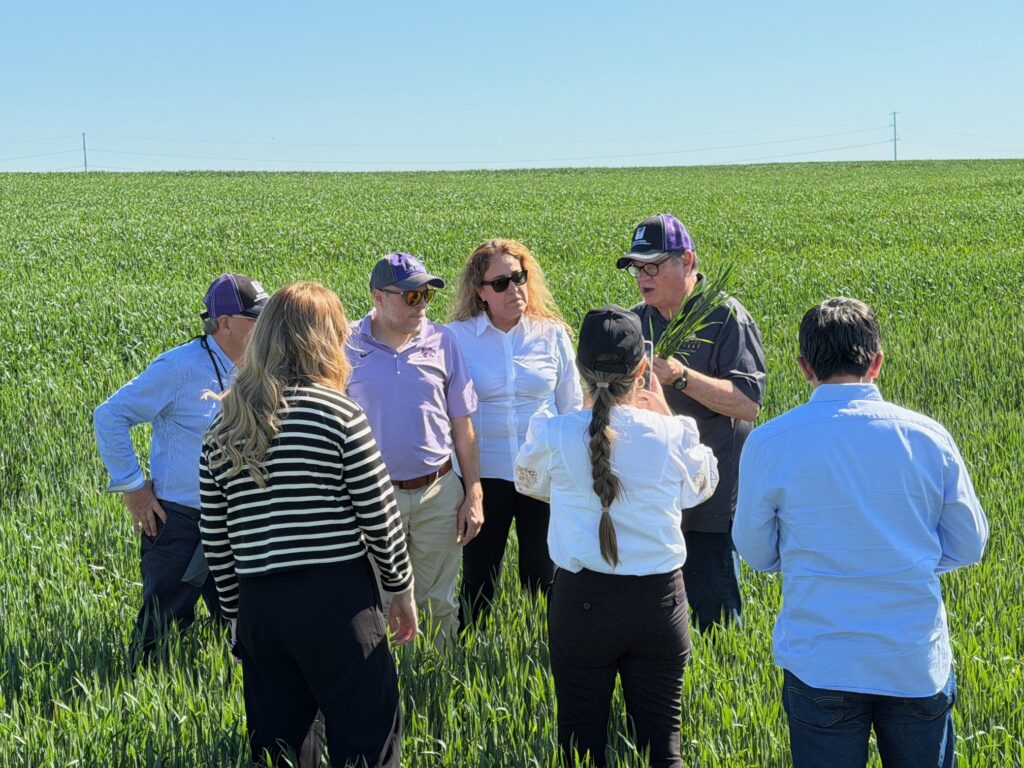
In mid-April, the team focused on providing participants with first-hand insights into how U.S. wheat varieties are bred and how U.S. wheat is produced, handled and positioned for international markets.
In Washington, the Washington Grain Commission helped coordinate meetings with wheat growers, breeders, traders and researchers. A farm visit to the Palouse allowed the team to learn more about SW wheat production practices, while visits to the Western Wheat Quality Laboratory and the Washington State University greenhouse in Pullman illustrated how wheat varieties are bred and tested. Aquaculture researchers joined the discussion to further compare research findings on the connection between wheat quality and aquaculture feed applications.
Next, the team traveled to Auburn University in Alabama, where they toured the university’s shrimp research facilities, including pilot-scale feed production and experimental extrusion capabilities. The discussions here focused on the latest research into shrimp production and digestibility.
Finally, the team went to Kansas, where the IGP Institute helped lead discussions on technical issues, including stops at the O.H. Kruse Feed Technology Innovation Center, a pilot-scale feed mill, and the Bioprocessing Industrial Value Added Center (BIVAP), which specializes in extrusion research. The Kansas Wheat Commission also helped coordinate farm visits and tours of grain elevators, as well as the USDA Federal Grain Inspection Service (FGIS) laboratory, which rounded out discussions on grain handling and official grading and inspection processes.
The Right Wheat for the Right Feed Formulation
The team departed the United States to return home to the Southern Hemisphere, now linked with U.S. wheat farmers and with a more solid understanding of the U.S. wheat production, marketing and export systems. U.S. Wheat will continue to engage with these key decision-makers as they put what they learned into action back at their companies.
“We have the opportunity to design an important link in the global food industry,” Blanc said. “This link is of added value and is an opportunity for U.S. wheat farmers and for commercial destinations wherever fish are farmed. As a technological link, it is a product of a fortunate mix of cultures in which the rigor of a scientific-commercial vision will be crucial to success.”
Ultimately, U.S. wheat farmers are set to gain an additional set of high-value customers by doing what the U.S. wheat supply chain does best: providing the right wheat for the right use to help end-use customers produce a more consistent and superior product.
“This initiative highlights aquaculture as a strategic pathway for demand growth in U.S. wheat, combining technical alignment with clear market potential,” said Claudia Gomez, regional marketing manager in the USW Santiago Office, who traveled with the team. “The experience in South America provides a strong foundation to further develop and scale this approach across other aquaculture markets globally.”