
U.S. Wheat Associates (USW) contributes success stories to the USDA Foreign Agricultural Service (FAS) to demonstrate the return on investment of market development programs, supporting continued federal funding for programs that identify, build and maintain international demand for all six classes of U.S. wheat.
A team from a Nigerian flour mill that had not been a regular buyer of U.S. wheat learned about the quality of hard red spring (HRS) wheat and the reliability of the U.S. supply chain during June 2026 visits to Kansas, Minnesota, and North Dakota sponsored by U.S Wheat Associates (USW). The trade team’s experience in the U.S. directly influenced purchases of 100,000 metric tons (MT) of U.S. wheat.
Using funding from the Regional Agricultural Promotion Program (RAPP), USW’s activity took place against a backdrop of rapid growth in wheat consumption across Sub-Saharan Africa. The outcome highlights the importance of relationship-building, technical education, and firsthand exposure to the U.S. grain supply chain in maintaining and expanding export opportunities.
Composed of senior executives from a Nigerian flour mill, the trade team explored transportation logistics, including grain handling and export infrastructure, while meeting directly with U.S. wheat farmers and others in the supply chain. Building buyer confidence and fostering industry relationships are important outcomes that support long-term export growth and competitiveness. The Kansas portion of the visit provided particularly valuable opportunities for engagement. The delegation toured the IGP Institute and the Kansas Wheat Innovation Center, where they discussed global trade dynamics, demand drivers, and advances in wheat breeding technology. Participants also visited Kansas State University agronomy fields to observe the wheat crop firsthand. These experiences helped demonstrate the continuous investment and innovation that support the quality and consistency of U.S. wheat production.
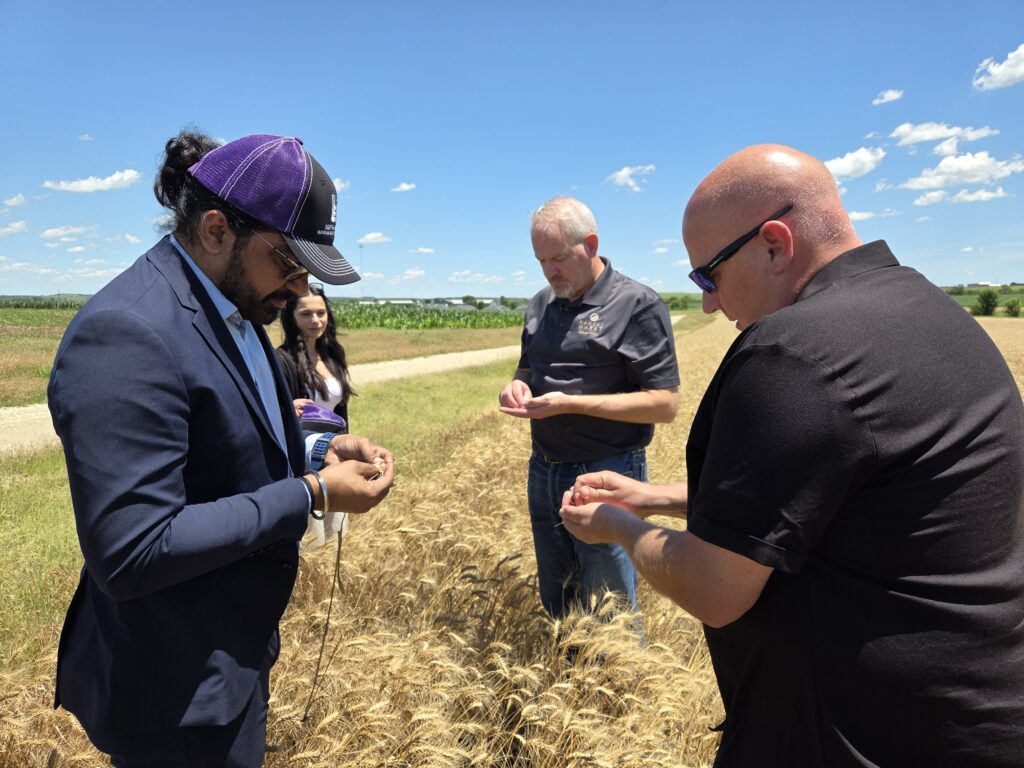
Members of a Nigerian flour milling delegation inspect the Kansas wheat crop alongside Kansas Wheat staff at Kansas State University agronomy fields during a June 2026 U.S. Wheat Associates (USW) trade mission.
One of the most significant moments occurred after the delegation returned to Nigeria. According to a participant, discussions with the company’s procurement team led him to recommend the purchase of HRS wheat due to quality, availability and current pricing. That recommendation contributed directly to subsequent wheat purchases. The result illustrates how educational trade missions can influence purchasing decisions by giving buyers firsthand knowledge of product quality, value and year to year changes in those metrics.
The success of this activity is particularly important given the strategic significance of Nigeria to U.S. wheat exports. With an estimated population of 240 million, Nigeria is Africa’s most populous country and one of the world’s largest wheat-importing nations. Over the past five years, it has ranked as the fifth-largest destination for U.S. wheat exports and remains the largest and most consistent buyer of U.S. wheat in Sub-Saharan Africa. Nigerian millers regularly import a mix of wheat classes, including HRS, hard red winter (HRW), soft red winter (SRW), hard white (HW), and durum wheat.
Despite its importance, the market has become increasingly competitive. U.S. market share in Nigeria declined substantially over the past decade as suppliers from Russia, Australia, Canada, Argentina, the European Union, and Ukraine offered lower-priced alternatives. Nevertheless, U.S. wheat sales to Nigeria expanded dramatically during the 2025/26 marketing year, reaching 1.65 MMT, more than double the previous year and making Nigeria the fifth-largest market for U.S. wheat.
Continued purchases throughout the year, despite significant price competition, underscored Nigerian millers’ willingness to source U.S. wheat when quality and performance justify the investment.