
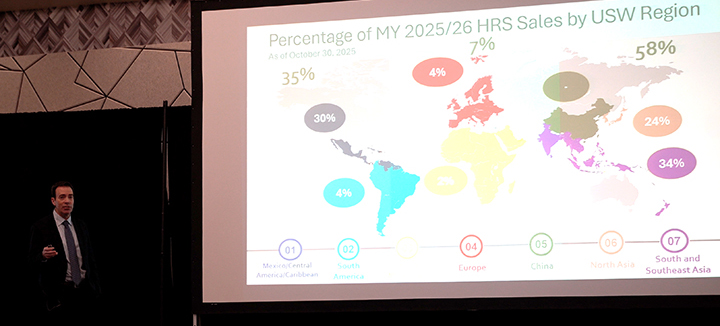
Wheat growers from Minnesota, North Dakota and South Dakota engaged fellow producers and attended research reporting sessions, committee meetings and marketing program updates during the annual Prairie Grains Conference, held December 10 to 11 in Grand Forks, North Dakota.
They had to brush up against Old Man Winter to do so.
But, as U.S. Wheat Associates (USW) Chairman and North Dakota farmer Jim Pellman put it from the event floor, “We’d be pretty alarmed if it wasn’t cold and snow to brave.”
The conference, a joint program of the Minnesota Association of Wheat Growers, the North Dakota Grain Growers Association and the Minnesota Soybean Research & Promotion Council, features meetings, breakouts, a trade show and keynote speakers.
“The 2025 Prairie Grains was a big success again this year, and even with the snowstorm early in the week, we had an attendance of 640 for the main conference and trade show,” said Brian Sorenson, executive director of Minnesota Wheat. “The conference is seen by many in the ag industry as one of the premier ag show and conferences in the Northern Great Plains, so we are happy to keep that tradition going.”
Spier Provides USW Update
USW President and CEO Mike Spier was one of the keynote speakers, presenting “Driving Global Demand: How USW Promotes U.S. Hard Red Spring Wheat and Delivers Value to Producers.” Spier highlighted USW’s work around the world to create and drive demand for all six classes of U.S. wheat. He included a special focus on U.S. Hard Red Spring (HRS) wheat grown by farmers in the region. Spier acknowledged the challenges U.S. producers face due to lower wheat prices and high input costs. He noted increased global wheat production, including record wheat crops in Argentina and Canada and large wheat output in Russia and Australia.
“The overseas activities conducted by our staff around the world are what will help generate demand in this environment,” Spier said, noting USW’s work to promote HRS wheat, which is critical since half of the crop is exported.”
Spier shared examples of USW’s work in the Philippines and Mexico, an effort to give examples of how USW programs in those markets, and all other markets, deliver value to producers across the U.S.
After his presentation, Spier spent time talking to farmers in attendance, answering questions about USW’s work. He also participated in interviews with farm broadcasters from the region who were eager to hear about USW programs and activities.
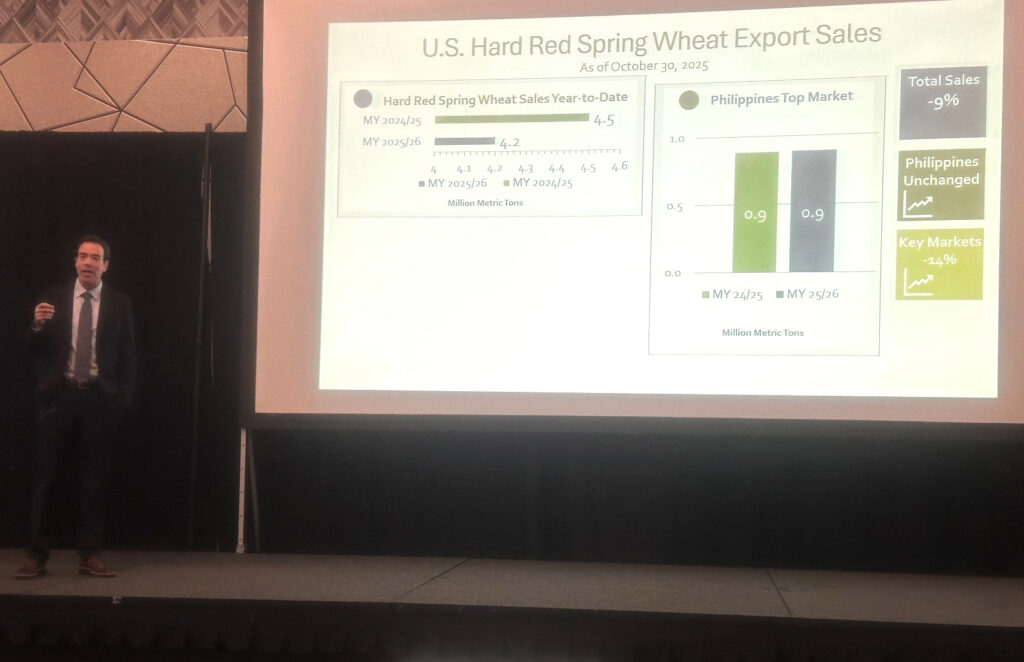
Pellman: Information Sharing is Important to Farmers
Pellman, who farms in McClusky – a 200 mile or so drive from Grand Forks – attended programs on both wheat and soybeans. He also attended a handful of other sessions built to keep farmers informed.
“You see people you know, and some of them you only see during this conference each year, so there’s a lot catching up and hearing about what other farmers are doing, or what conditions are in their part of the state,” Pellman said. “Wheat farmers are always looking for an update on the global markets, so the presentation by Mike Spier was popular. It was a very solid look at our work and efforts.”