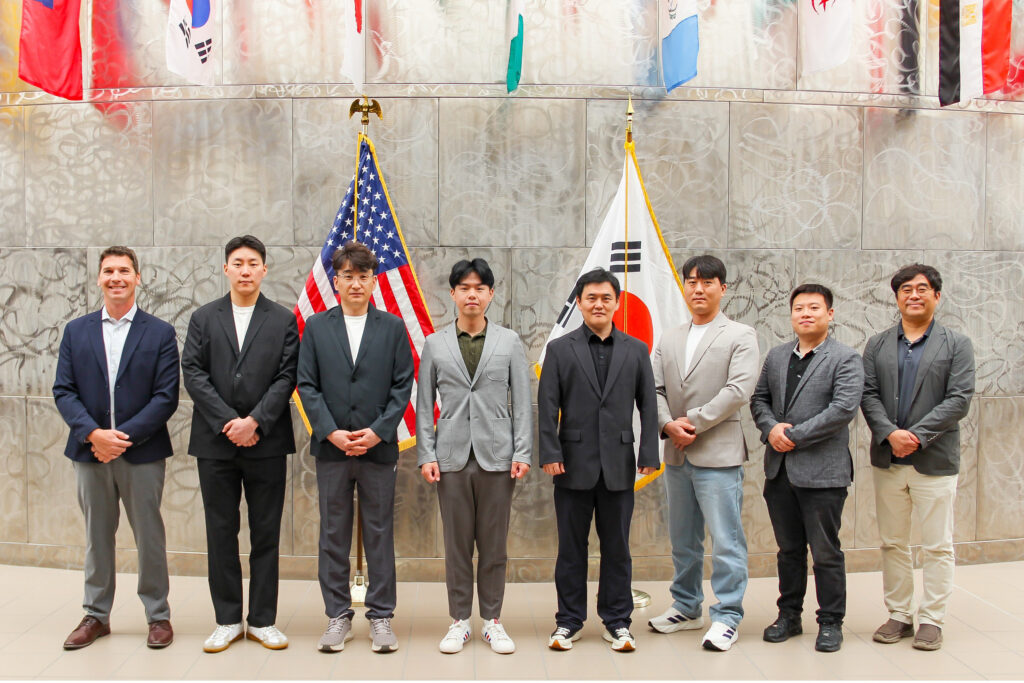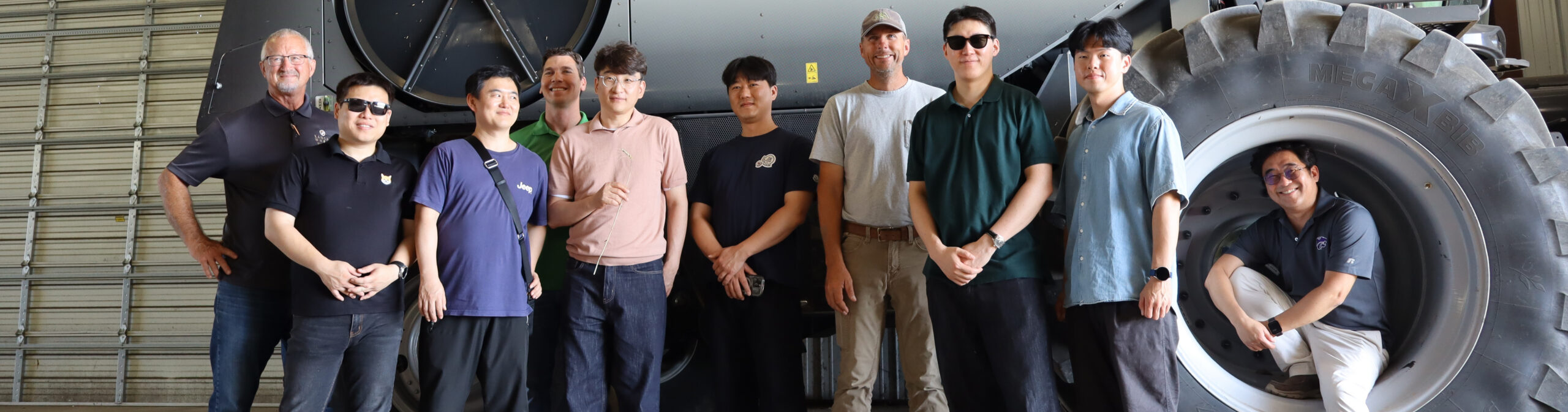
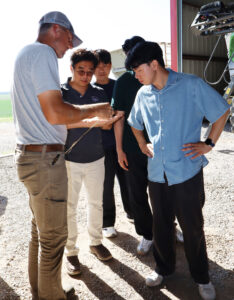
A kernel of wheat is a type of common language, according to wheat farmer Justin Knopf, who recently hosted a team from South Korea, sponsored by U.S. Wheat Associates (USW), on his farm near Gypsum, Kansas.
“Anyone in the wheat business appreciates putting their hand into a bucket of wheat, examining the kernel characteristics, maybe even popping a few kernels in their mouth for a chew,” Knopf said. “Even though I couldn’t speak Korean and some of the team members needed English translations, that kernel of wheat is a common language between us.”
The South Korean team was in Kanas as part of an advanced milling course based at the IGP Institute on the north campus of Kansas State University in Manhattan, Kansas. The course was the fourth of its kind in five years, customized to bring mill production managers from South Korea to the United States to gain valuable, technical information on advanced milling processes that they can take back to their home mills.
David Oh, food/bakery technologist in the USW Seoul Office, emphasized that the training at the IGP Institute leads to measurable real-world outcomes, specifically higher flour extraction rates in the participating mills.
Milling Training Leads to Real-World Results
In addition to lectures and discussions, the team engaged in practical milling exercises at the Hal Ross Flour Mill. While South Korean buyers typically purchase wheat from the Pacific Northwest, the facilities in Manhattan, Kansas, provide hands-on experience that is ideal for achieving the course’s objectives.
“One of my past participants reported that using this course, they improved their milling processes to get a better flour production rate through improved extraction rate at their facility,” said Oh, who expressed his appreciation for Shawn Thiele, milling specialist and IGP associate director, who led the course. “Shawn is an expert in milling techniques; he gave such valuable information to our customers. Every year, I keep requesting how to refine our technical IGP milling advanced course, and he is always very positive about exchanging opinions to improve the course year after year.”
Following the coursework, the team took to the road to tour the Kansas grain supply chain, including visits to Knopf’s farm, a grain elevator and a U.S. commercial mill. Because this was the participants’ first trip to the Midwest, these tours answered their questions about how U.S. wheat is grown and transported before arriving in South Korea.
“My team was very interested in wheat production in the Great Plains,” Oh said. “When they saw the wide range of fields and large-scale operations, they were impressed by the scale and by all the science used throughout the supply chain.”
Firsthand Experience Leaves Lasting Impressions
Ultimately, the combination of top-tier milling science with firsthand views of the size and scope of U.S. wheat farmers equipped this team with the knowledge they need to improve their own milling operations and a lasting positive impression of the quality, reliability and value of U.S. wheat. Both Oh and Knopf emphasized that those impressions strengthen commercial ties and customer trust for years to come.
“I’m proud of the work that we do here, and I’m honored to be able to share that work,” Knopf said. “Selling wheat out of the U.S. is really important, even if it’s not coming out of Kansas. We need to be supporting all export markets because if South Korea is buying wheat out of Montana or the PNW, that’s one more market that the U.S. wheat supply is able to meet that demand. The more demand we can create for all U.S. wheat, the better it is for Kansas wheat farms as well.”