
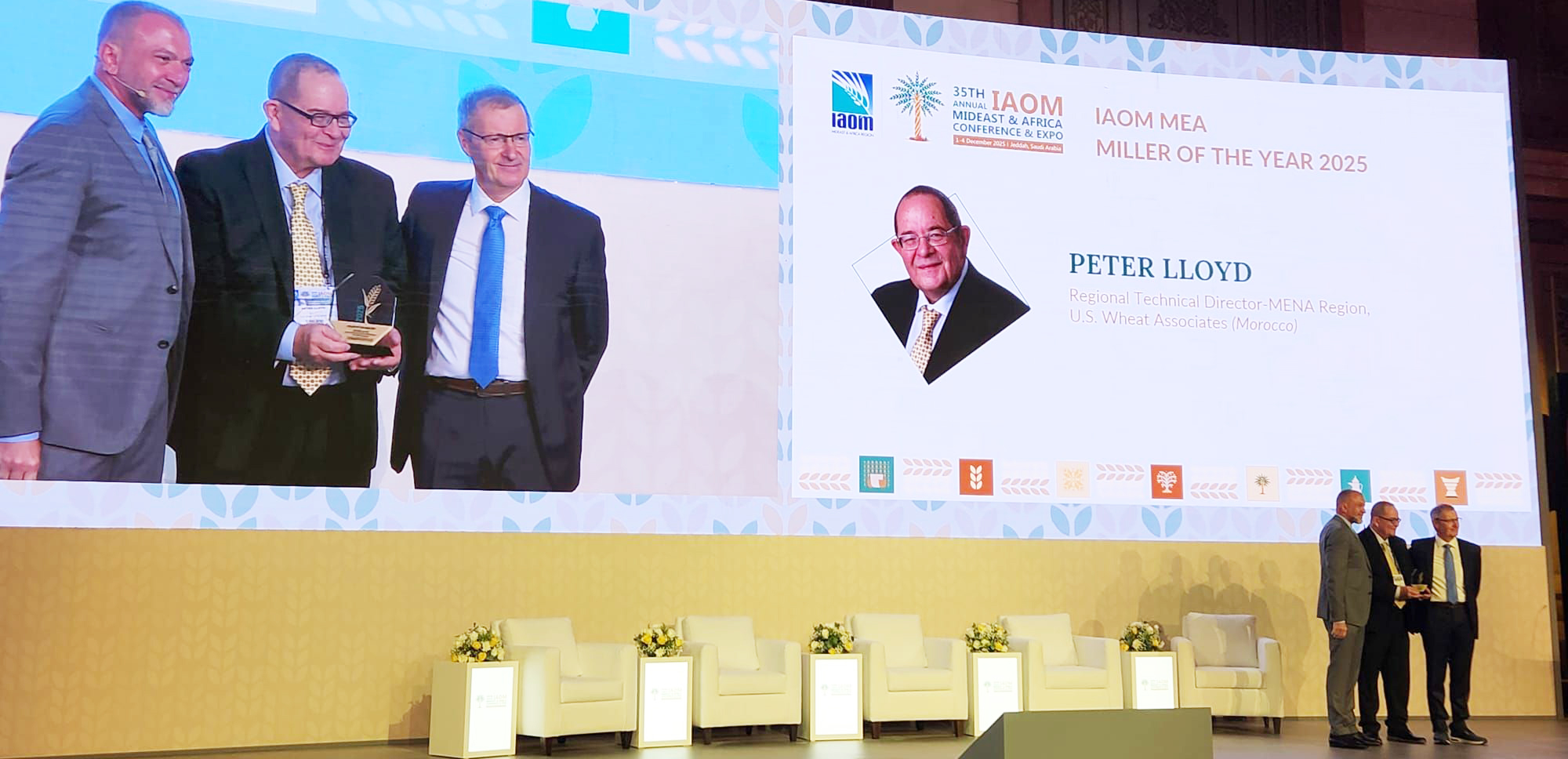
Peter Lloyd has a long history of inspiring flour millers.
So much so that the International Association of Operative Millers Mideast and Africa Region (IAOM MEA) named him Miller of the Year during their December conference in Saudi Arabia.
“Peter’s influence extends worldwide,” IAOM MEA stated.
And how.
Lloyd is regional technical director for U.S. Wheat Associates (USW), based in Casablanca, Morocco. The office manages technical activities across the Middle East, Africa and Europe, and supports other USW offices, including China, Taiwan, the Philippines, Indonesia and occasionally Malaysia and South America.
Lloyd designed, commissioned and managed flour milling operations in multiple countries. He developed innovative training programs and software tools and served as a technical consultant in China, Chile, the United States, Brazil and Italy.
“Through his work with USW, Lloyd has supported mills across North Africa, the Middle East, parts of Asia and beyond, acting as a bridge between wheat producers, researchers and millers,” IAOM MEA officials stated. “By honoring him as Miller of the Year, IAOM MEA is also recognizing the value of long-term technical mentorship and knowledge transfer that underpins safe, efficient and competitive milling in the region.”
“To receive the recognition of your peers is a very humbling experience,” Lloyd told Capital Press during a Zoom interview Dec. 10.
Northwest Connection
Lloyd’s long career includes a stint as chief analytical miller at the Wheat Marketing Center in Portland. He often has returned to deliver annual presentations about milling wheat for Asian noodles.
Today, Lloyd doesn’t interact with Pacific Northwest farmers “as often as I would like.”
He estimates that he visits the U.S. about twice a year, working with North Dakota State University’s Northern Crops Institute.
“I’m very grateful to the farmers and producers that I work for, and particularly the farmers in the PNW and the northern tier — those are the guys that I know the best,” Lloyd said. “From North Dakota all the way across to the very, very westernmost point of Washington State, I have a very soft spot for them. And also California and Arizona have been very good to me, too.”
“He’s just a delight to be around,” longtime Winchester, Idaho, wheat farmer Bill Flory said. “He’s calm, he’s credible. When he talks wheat quality and wheat trading, people listen. When you say ‘Peter Lloyd,’ I just smile, because he’s that good and that well-regarded.”
Flory worked with Lloyd as a USW board member and chairman of the Wheat Marketing Center board of directors.
“Peter may be from the North Africa-Spain-Mediterranean part of the world, but he knows wheat everywhere,” Flory said. “Working for farmers, he understands the competitive world we’re in, and millers and bakers are in. Millers and moreso bakers really appreciate the fact that he understands that they need consistency. He’s got the whole picture.“
“People just don’t realize what all he’s done for the industry,” said retired Washington wheat farmer Randy Suess, a former USW chairman and now president of the Washington Wheat Foundation. “He knows so many people and he’s so knowledgeable. At many IAOM meetings, the people would come to him and ask him a technical question, and he could give them an answer.”
Lloyd’s impact is “tremendous,” Suess said.
“I think he had a real soft spot for our soft white wheat that we grow,” Suess said. “Every time I was in contact with him, he’d always tell me, ‘OK, we’re working on this for you soft white guys.’ It was really top of mind for him, which I appreciated.”
Soft white wheat is primarily grown in the Pacific Northwest, with approximately 80% bound for export overseas.
Soft White Wheat
“I’m a very big fan of soft white wheat,” Lloyd agrees. “It’s one of the best we have in the U.S. It’s clean, it’s dry and it’s white. That’s what makes money. It’s generally a higher-value commodity than perhaps sometimes it merits.”
Dryness is worth “a lot of money” to a flour miller, Lloyd said.
“We have to temper wheat to get it to the right condition for milling,” he said. “When you get soft white wheat coming in at 9% moisture, and less than 1% impurities inside it, that’s money in the bank.”
In Morocco, one percentage of moisture is worth $8 per percent per ton to a miller. About 1% of extraction — the percentage of flour obtained from the wheat — is worth about $4.50 per ton.
“These tons build up — you’ve got mills in this part of the world that are milling 1,000 tons a day,” Lloyd said. “So the numbers become huge over time.”
U.S. soft white wheat generally doesn’t have the same amount of dust found in other parts of the world, he said.
“Because it’s a white wheat, the possibilities for obtaining higher extraction is significant,” Lloyd said.
Soft white also blends well with other wheats, particularly higher-protein varieties.
“When you blend those with spring wheat, it’s amazing what you can do with that,” Lloyd said. “The two types of protein work in harmony with each other. You can come up with new products that perhaps you hadn’t tried before.”
Club wheat, a popular subclass of soft white used in Western White wheat blends, is “probably the most resilient of all the soft whites,” he said.
Profitable Outcomes
“Peter Lloyd is among the most valuable technical experts at USW,” said Roy Chung, another longtime USW icon. Chung retired in December 2024, but continues to work as a consultant.
“Although U.S. wheat is often not the cheapest option on the global market — and in many cases may even be considered one of the most expensive — Peter has consistently helped customers understand the balance between cost, value and overall profitability,” Chung told Capital Press. “He has developed numerous lectures that present the financial aspects of flour milling in a clear, practical way for millers.”
Chung worked with Lloyd while advocating for adoption of the solvent retention capacity profile, to distinguish U.S. soft wheat from competing wheats around the world.
The collaboration demonstrated how millers and bakers can work together “synergistically” to achieve “the most effective and profitable outcomes for users of U.S. wheat,” Chung said.
As a result, soft white wheat is exported consistently to markets in South and Southeast Asia — regions that previously relied on Australian wheat, Chung said.
“This shift has had a meaningful positive impact on the bottom line for our farmers,” Chung said.
New USW CEO Mike Spier has worked with Lloyd for 30 years. The Miller of the Year recognition is “true testament to his experience, professionalism and work ethic,” Spier said in a statement.
“Peter’s technical experience and willingness to share his knowledge — wherever he is in the world — have set a high standard for our organization,” Spier stated. “Early in my career, I had the opportunity to train with Peter, and his passion for milling and commitment to excellence left a lasting impact on me.”
Promising Markets
Yemen, Iran and the Persian Gulf used to be large customers for soft white wheat. In fact, the soft white wheat grown in the Pacific Northwest originates from Iran, Lloyd said.
Then farmers in Saudi Arabia had to cut back on the amount of water they were using for irrigation. So they began growing their own hard red winter wheat — a variety originating from the San Joaquin Valley in California. The variety tolerates the dryness of Saudi Arabia, Lloyd said.
“They just took off with that,” he said. “They were able to produce huge amounts of wheat and even export from there.”
While markets in the Middle East and Africa have shifted away from soft white wheat, Lloyd believes “very strongly” the market for the crop will build back up in the region.
USW expects Sub-Saharan Africa to be a leader in wheat import growth over the next 25 years, and held its first buyers conference there in 2025.
The east coast of Africa could very well come into play, Lloyd said. In years where competitor Australia has a bad crop, demand for U.S. soft white wheat is generally much higher.
Breads that are common and in high demand in the Persian Gulf are “well-suited” to soft white wheat, Lloyd said.
Containerized Soft White Wheat
Lloyd would like to see an increase in the number of people offering containerized wheat, as a way of increasing sales, adding to the market share already using bulk vessels.
“We do bulk vessels better than most, in the U.S.,” Lloyd said.
If it were possible, he would love to see containers handled more directly by the U.S. Federal Grain Inspection Service, which he considers “the Gold Seal of Quality Assurance.”
The U.S. Federal Grain Inspection Service is “one of the greatest resources we have in the wheat industry,” Lloyd said, providing “an outstanding level of quality of trade assurance.”
“It’s very real; people will buy our wheat because it is quality-assured by FGIS,” he said. “No one else has it.”
‘Finest Organization’
Born in Kenya, Lloyd’s father was a flour miller. His mother’s family delivered wheat to the mill his father ran.
He began his career in 1977 with Henry Simon Ltd. in England, as a technical miller commissioning flour mills in Europe and Africa.
He ran a flour mill in Botswana, then worked as a milling specialist in Denmark, commissioning Danish International Development Agency projects in China and Uganda.
Lloyd first joined USW in 1991, to manage responsibilities for developing a new Egyptian milling school in Cairo, and seeing it through its first two years of operation, leading “transformative” technical education initiatives.
“USW is the finest organization I’ve ever worked for,” he said. “I’ve been blessed beyond measure to have had this job, and for the fine people I’ve met and worked with.”
He was particularly touched during the COVID-19 pandemic shutdown. The first day everyone was told to stay home, then-president Vince Peterson sent an e-mail to staff members: “Don’t worry, guys. Focus on looking after your families and yourselves. You’re taken care of.”
“USW’s in it for the long run, both internally and externally,” Lloyd said. “If I had to do my whole life over again with USW, I wouldn’t change a thing.”
Making the Connection
Lloyd isn’t leaving USW any time soon.
He foresees shifting into more of a coach-mentor role for his “powerful young team of technicians” in flour milling, baking and quality control.
“I think I still have quite a lot to contribute,” he said. “If you can build your own redundancy, I think you’ve accomplished your job.”
Upon Lloyd’s arrival in Morocco, a longtime mill worker approached him at the end of a two-day training event in Fez.
“He said, ‘I want to thank you. I’ve worked in my job for 43 years. Nobody explained to me the importance of my job in the overall operation of the mill,’” Lloyd recalled. “That is that joy, when you see the light go on in people’s eyes and they make the connection: ‘Wow.’ That’s the most rewarding thing ever.”
This article was written by Matthew Weaver and originally published by the Capital Press. Read the original article here.