
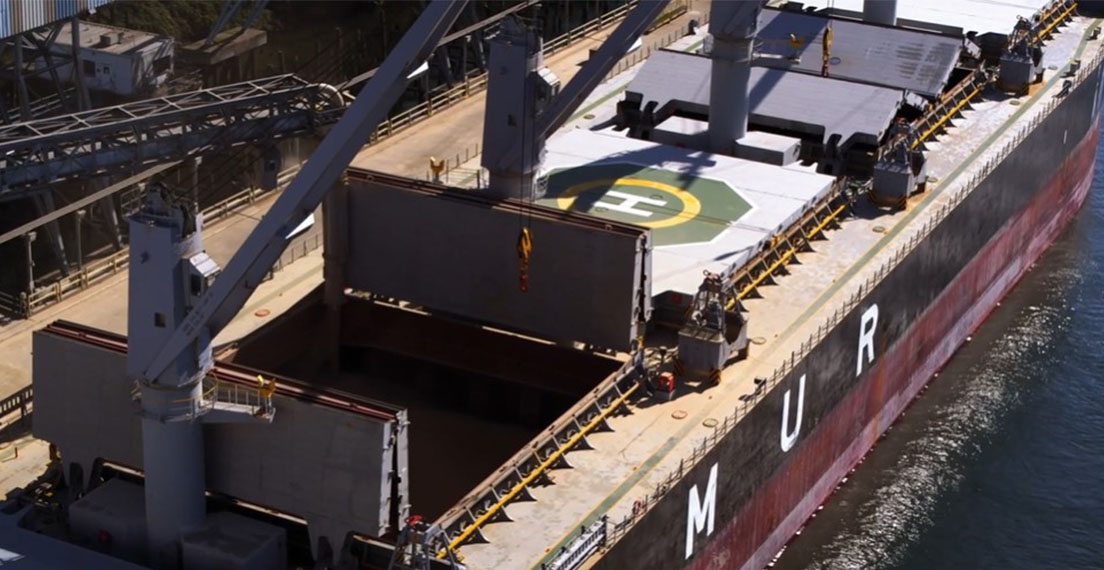
In recent weeks, the risk of Section 301 actions targeting China’s shipbuilding industry have hung heavily over the wheat exports. The proposed actions and associated risks have dampened exports, with new crop wheat sales sitting 18% below last year’s level, as of April 10. However, after weeks of uncertainty, the April 17 determination offered crucial insights and clarity that should ease freight risks.
Concurrently, U.S. wheat prices have stabilized, a stark contrast to the unprecedented volatility of recent years driven by war, drought, and economic uncertainty. The absence of a discernible downward trend further suggests that the markets have stabilized at their current levels. Notably, the spread between U.S. HRW and the cheapest global origins has narrowed in recent months, positioning U.S. wheat classes at their most competitive price levels since 2020.
Bulk Wheat Shipping Sheltered
On April 17, the office of the U.S. Trade Representative (USTR) issued final determinations on the Section 301 actions, considering Federal Register comments and public input. These determinations will implement phased fees on Chinese vessel operators and owners, as well as on Chinese-built vessels based on net tonnage, taking effect in 180 days and increasing incrementally over three years. Notably, Chinese-built bulk vessels under 80,000 tons deadweight or those arriving empty in the U.S. are exempt.
While the market is still assessing the exact implementation of the rulings, wheat vessels are generally expected to be exempt from significant impacts. U.S. Wheat Associates (USW) and the National Association of Wheat Growers applauded the USTR for adjusting the proposed remedies that help protect U.S. export competitiveness.

U.S. Wheat Increasingly Competitive
As noted earlier, U.S. wheat competitiveness has steadily increased throughout 2025. Notably, U.S. soft red winter (SRW) has been the most competitive global origin since early March 2025, the longest competitive window since before the Russian invasion of Ukraine. U.S. soft white (SW) is a close second, priced approximately $10/MT above SRW. Moreover, the spread between U.S. Gulf hard red winter (HRW) and the cheapest global origin (Russian) was over $56/Mt in April 2024. In April 2025, the spread between HRW and the low-cost origin (U.S. SRW) has narrowed to $23/MT. U.S. Gulf HRW also remains competitively priced against other origins, trading within $6/MT of French and Argentinean wheat, within $11/MT of Ukrainian wheat, and $2/MT to $6/MT below competing wheat classes from Russia, the Baltic Sea, Germany, and Poland on a Free on Board (FOB) basis.
Relative to corn, SRW sits just $8/MT above Gulf corn on a FOB basis, the tightest margin since September 2023. Similarly, the spread between Ordinary U.S. SW and PNW corn is also $8/MT, nearing levels that stimulated South Korean feed demand during the 2024/25 season.

Other Factors
Given competitive pricing and reduced freight risks, U.S. wheat presents an attractive option for importers, particularly with the 2025 harvest approaching. Seasonal trends suggest that basis levels will generally decrease further, typically reaching seasonal lows during harvest. Timely moisture remains crucial in U.S. HRW growing areas and the Black Sea due to existing weather risks, and ongoing trade policy shifts add further uncertainty.
Nevertheless, the combination of a weaker dollar, decreasing basis, normalized price trends, and eased freight risks offers an opportunity for international buyers to capitalize on the recent competitiveness. Backed by exceptional quality and USW’s superior customer service, U.S. wheat offers outstanding and timely value.
By USW Market Analyst Tyllor Ledford