
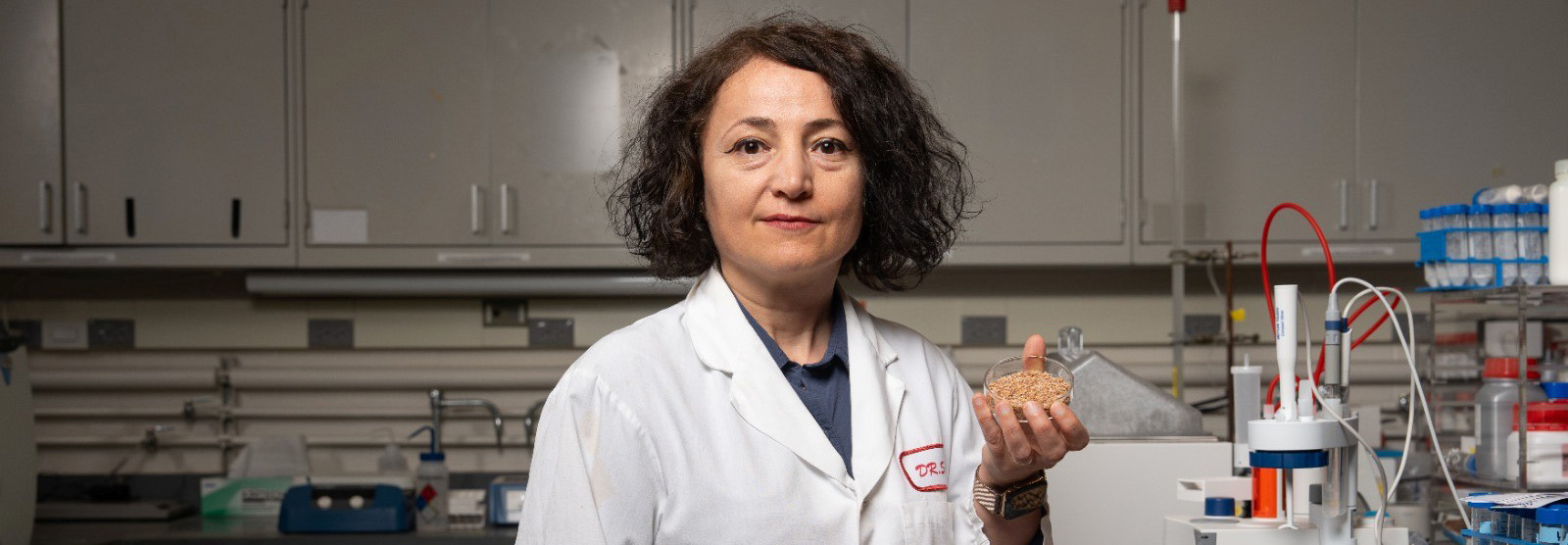
Understanding wheat, improving the foods made from it and sharing knowledge has defined Dr. Senay Simsek career as a cereal scientist and researcher. It has also made her a valued technical expert for U.S. Wheat Associates (USW), helping international customers better understand the quality, functionality and value of U.S. wheat.
Today, Simsek serves as department head and professor in Purdue University’s Department of Food Science. Prior to returning to Purdue – she earned a PhD there in 2006 – she spent 15 years at North Dakota State University, where she became a leading wheat quality expert. Her career has taken her from her native Turkey to leading American food science programs and wheat markets around the world.
She’s made a truckload, trainload and shipload of friends along the way. And she’s earned bushel baskets full of respect, praise and accolades.
In 2026, Simsek’s body of work earned one of cereal science’s most prestigious honors. The International Association for Cereal Science and Technology (ICC) selected her as the recipient of the 2026 Harald Perten Prize, awarded every two years for outstanding achievement in cereal science and technology, including research, teaching and knowledge-sharing. She is set to accept the award in October at the 9th International Conference on Dietary Fibre in the United Kingdom.
For Simsek, however, some of the most meaningful work happens outside the laboratory and classroom – when scientific knowledge can be shared directly with the people who turn wheat into food.
That is where her long-standing partnership with USW as a technical expert has made an important impact.
A Passion Rooted in Food and Culture
Born and raised in Turkey, Simsek grew up in a culture where food is deeply woven into family, community and tradition. Meals were never simply about nourishment; they were a way of bringing people together during some of life’s most important moments.
“Whether we are celebrating a wedding, gathering after a funeral or welcoming someone into our home, food is always part of the experience,” Simsek said. “It is part of how we connect with one another, and it is deeply rooted in our culture.,” Simsek said.
Her curiosity about science began just as early. As a middle school student, Simsek saved her allowance to buy a Turkish science and technology magazine, eagerly reading each issue and nurturing a fascination with chemistry. That curiosity eventually led her to earn a bachelor’s degree in chemistry and a master’s degree in biochemistry..
In 2002, she came to the United States expecting to stay for only three months. Instead, that short visit changed the course of her career. She enrolled at Purdue University and earned her doctorate in food science in 2006, specializing in food chemistry.
It was at Purdue that Simsek began to see something familiar through an entirely new scientific lens: wheat.
“That was when I realized just how much science and chemistry there is in food—and particularly in cereal grains,” she said. “In Turkey, wheat is almost sacred. Bread is on the table at every meal. Wheat is not just a crop; it is deeply connected to our food, our traditions and our everyday lives.”
For Simsek, cereal science became the natural meeting point between the subject she loved intellectually and the food that had surrounded her throughout her life.
“My passion for chemistry and my connection to food and cereal grains came together,” Simsek said. “I realized that I truly loved what I was doing. Cereal science gave me the opportunity to bring two of my greatest passions together – wheat and chemistry – and to use science to better understand something that touches people’s lives every day.”
Taking Wheat Science to the Customer
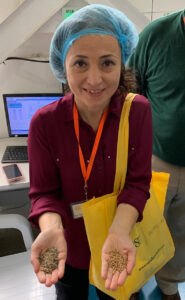
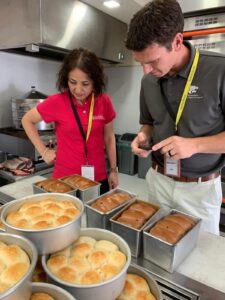
Over the years, Simsek has traveled with USW to international markets, meeting directly with millers, bakers and food industry professionals. Those experiences have reinforced a fundamental principle behind USW’s market development mission: understanding the customer is just as important as understanding the product.
As an expert in wheat quality and cereal chemistry, Simsek brings highly technical knowledge to customers who need practical answers. Her work helps explain why different classes of U.S. wheat perform differently and how wheat characteristics influence milling, flour quality and finished products.
Her international engagement has taken her to markets across four continents. Before meeting with customers, she studies the foods they produce, the ingredients they use and the types of wheat they purchase.
“The goal is not simply to teach wheat science,” Simsek said. “It is to connect science with real-world needs—helping customers unlock the full potential of U.S. wheat and create products that perform better and truly meet the expectations of their consumers..”
Joe Sowers, then USW Regional Vice President for South and Southeast Asia, has seen firsthand the value Simsek brings to international customers.
“Dr. Simsek presents information to overseas millers and bakers that gives them an advantage in producing superior products,” Sowers said. “Her expertise offers valuable information for experienced industry professionals while remaining accessible to those newer to cereal science and milling.”
Simsek has also been part of USW Crop Quality Seminar teams presenting the latest information about U.S. wheat directly to overseas customers. In 2025, she participated in USW activities in South America, helping present crop quality information to customers in Peru, Colombia, Ecuador, and Chile.
These seminars give customers an opportunity to hear from researchers, industry representatives and farmers about the characteristics and performance of the U.S. wheat crop.
Building a School Around Wheat Quality
One of Simsek’s significant contributions to USW’s educational mission has been helping develop the School of Wheat Quality. USW collaborated with Simsek and other technical experts to create an intensive program designed to give international millers and bakers a deeper understanding of cereal chemistry and wheat quality. The program takes participants through the scientific principles that influence wheat and flour performance –from characteristics of the kernel to the finished food product.
Originally delivered through intensive virtual sessions for customers in South and Southeast Asia, the program has evolved into a continuing educational resource available through USW.
That commitment to education also led Simsek to develop the Wheat Quality Handbook, a resource widely used in USW’s technical training programs.
Welcome to North Dakota
After earning her Ph.D., Simsek accepted a position as a faculty member at North Dakota State University. She moved to North Dakota in December 2006, just weeks before beginning her new job.
There was one aspect of her new life she had to learn to appreciate: winter. One morning, while driving to work, she heard the weather report on her car radio.
“The announcer said the weather is ‘warming up to minus 15 this morning,’” Simsek recalled.
She laughed out loud. By herself. In her car.
“It was early in the morning and I thought, where else can you hear this weather is ‘warming up to minus 15?’”
Eventually, she realized there was a lesson in that unusual forecast.
“Then I realized it hit me – the ‘warming up’ was something I should appreciate.”
North Dakota turned out to be an important chapter in Simsek’s career. Wheat is central to the state’s agricultural economy, and she applied her chemistry background to understanding and improving wheat quality.
“I had very productive and successful years in North Dakota as a wheat quality specialist,” she said. “The uniqueness of my expertise and my service to the wheat industry was because I was trained as a chemist.”
Her approach was to understand problems at the molecular level and then connect those interactions to practical outcomes – how they affect bread quality, shelf life and other characteristics important to the food industry.

Connecting with USW
Simsek’s relationship with U.S. Wheat Associates had been developing for some time. During her years in North Dakota, she regularly hosted visiting trade teams, sharing her research and expertise in wheat quality with customers and industry representatives from around the world. But one visit, around Halloween, became a turning point in that relationship.
A trade team from the Philippines was traveling through North Dakota, and Sowers asked Simsek if she would meet with the group in a hotel conference room on a Saturday.
“I said, ‘Absolutely,’” Simsek recalled. “I thought I would go to the hotel, talk about my research program and our wheat quality work, answer their questions, and spend some time with the group.”
What she expected to be a relatively brief meeting quickly became a much deeper conversation.
“They were incredibly engaged,” she said. “They asked thoughtful questions, and we had such meaningful discussions about wheat quality, functionality and how wheat performs in their products. I ended up staying much longer than I had planned because the conversation was so engaging.”
The interaction resonated with the visiting team. Afterward, one member told Sowers that Simsek had an exceptional ability to make complex wheat science understandable and relevant to industry, and suggested that she travel to the Philippines to conduct a seminar or workshop.
That visit did not begin Simsek’s connection with U.S. Wheat Associates, but it marked an important turning point—transforming a series of interactions with visiting trade teams into a deeper and more sustained partnership.
Since then, Simsek’s combination of scientific expertise, teaching ability and passion for wheat has taken her into classrooms, laboratories, mills and meeting rooms around the world. Through that work, she has helped millers, bakers and technical teams understand not only the science behind U.S. wheat, but how to apply that knowledge to solve practical challenges and create better products for their markets..
Passing It Along
Those qualities have also shaped the way she shares her work with her family.
Simsek is the mother of four children. Her oldest, 23, is pursuing a Ph.D. in biochemistry and molecular biology. Her second child, 20, is studying mechanical engineering. Her third is a 17-year-old high school senior, while the youngest is 11 and in fifth grade.
When her children were younger, they did not always understand exactly what their mother did for a living.
That has changed.
“Now they do, especially the older three,” Simsek said. “They understand definitely what I do and they ask me questions.”
Her work has even found its way into family life.
“We bake together,” she said, recalling how she has helped with chemistry homework and brought her children into her world of food science.
Her oldest daughter has also seen that world firsthand. She once accompanied Simsek to a buyers conference and watched her mother make a presentation and interact with professionals from different countries.
For Simsek, those moments are another reminder of why she chose food science in the first place.
After nearly two decades of research, teaching and international engagement, she continues to see wheat as a powerful connection between science and people.
Through her partnership with USW, that connection extends from U.S. wheat farmers to millers, bakers, and food manufacturers around the globe.
Wheat ultimately becomes food.
And food, as Simsek has understood since childhood, brings people together.