
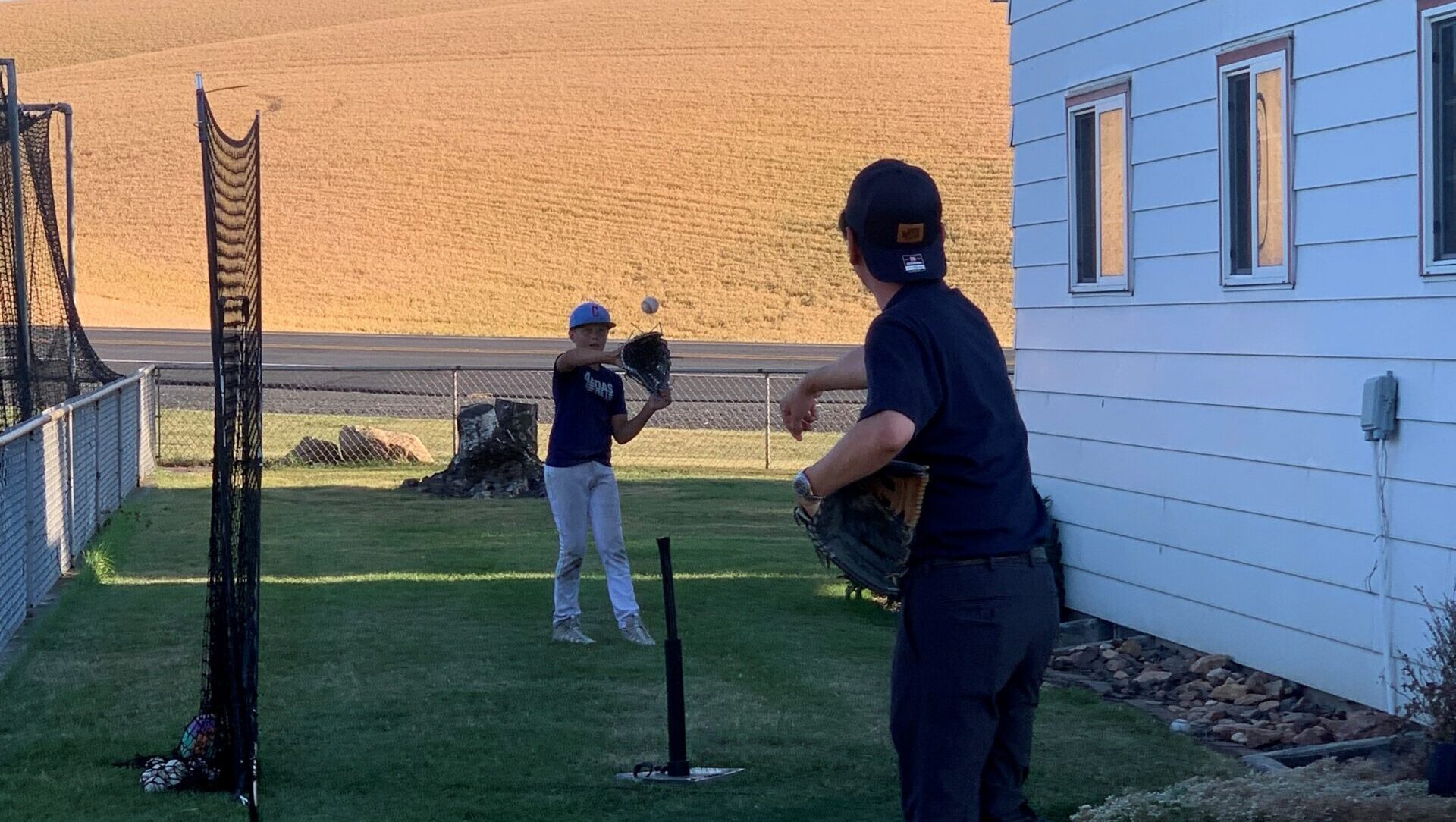
A U.S. Wheat Associates (USW) trade team from Japan visited Colin Schultheis’ family’s wheat farm in Colton, Wash., in July, just as Colin got home from baseball practice.
Colin, 10, is a 5th grader who plays center or first base on two different baseball teams four days a week.
Takahiro Ishizuka with the NIPPN Corporation spotted Colin in his baseball gear.
“Colin was wearing a baseball cap, so I could tell right away that he played baseball,” Ishizuka said.
Ishizuka has three children of his own — two elementary schoolers and a 3-year-old.
“I wanted to talk with him, but I am not very confident in my English,” Ishizuka said. “So I said, ‘Let’s play catch!’ and that is how we ended up playing together.”
Colin ran and grabbed his mitt, and one for Ishizuka. They played catch in the Schultheis’ yard.
“It was really fun,” Colin said.
Ishizuka joked that he was Shohei Ohtani, the Japanese designated hitter and pitcher for the Los Angeles Dodgers. They’re both huge fans of Ohtani.
That meant “he really liked baseball and I liked him,” Colin said.
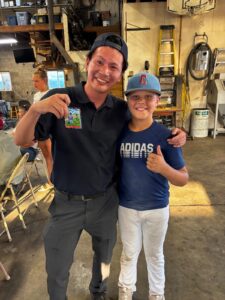
“It’s one of those moments that you don’t anticipate, but it was pretty cool to watch,” said Kyle Schultheis, wheat farmer and Colin’s dad. “Not only was Colin excited, but I’m pretty sure the gentleman was more excited. It was just an awesome moment.”
“They didn’t speak the same language, but they spoke baseball,” said Art Schultheis, Colin’s grandfather, a Washington Grain Commission board member.
“The experience taught me that even if my English is not perfect, there is nothing to be embarrassed about in wanting to communicate with someone and simply giving it a try,” Ishizuka said. “Sometimes you can find a way to connect even without many words.”
Upon his return to Japan, Ishizuka said he proudly told his children that he had played catch with Colin.
“My son told me that he would like to play catch with him someday, too,” Ishizuka said. “It was a very special experience for me and one that I do not think I will ever forget.”
Baseball Cards
Colin also collects baseball cards.
How many does he have?
“Lots,” Colin said.
Which card is his favorite?
“Um, I don’t know — all of them,” Colin said.
“He has his dad’s collection, too,” mom Stacie Schultheis said.
Colin had used an app to make a baseball card for himself several years before.
Ishizuka asked for something Colin could sign. Colin thought of the card and ran and got it, signed it and gave it to Ishizuka, who gave his own business card to Colin.
Ishizuka told Colin he would show the card to his family and everyone he knows.
How did that make Colin feel?
“Pretty happy that it’s in Japan,” Colin said.
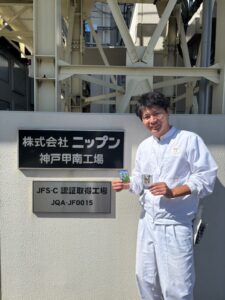
Ishizuka still keeps Colin’s card “safely in my business card holder at work. From time to time I show it to people and proudly tell them, ‘I have the autograph of a future Major Leaguer!’
“I plan to keep his card and treasure it for many years to come,” Ishizuka added.
Seeing Wheat Firsthand
NIPPN was founded as a flour-miling company 130 years ago and holds the second-largest share of Japan’s flour milling market. NIPPN invested in the newly established Utah Flour Milling LLC, marking the company’s entry into the U.S. flour milling business.
Ishizuka participated in the trade team to see firsthand how wheat is grown, harvested, and shipped, to deepen his understanding of the entire process.
He was “amazed” by the “tremendous scale” of wheat production.
“I was particularly impressed by their commitment to sustainable farming,” he said. “Seeing how farmers work under challenging natural conditions while striving to minimize their environmental impact gave me a greater appreciation for the safe, high-quality wheat that we are able to use to produce flour in Japan.”
What does it mean to Kyle Schultheis to have users of the wheat visit his farm?
“Boy, that’s everything,” he said. “It just helps validate the work we do. It’s important to solidify those relationships. You look at the world right now, and we need those foreign markets to buy our wheat to keep our farms alive.”
Life on the Farm
The Schultheis family raises wheat, and other crops, on about 2,000 acres.
“It’s pretty fun to help move and do all that stuff,” Colin said, noting he helps to move pick-ups or a four-wheeler back and forth.
Colin and sister Bria, 13, help with little projects before harvest, including cleaning out grain bins, painting trailers and fixing a mud flap on a semi-truck.
He helped show the trade team around on the four-wheeler.
The best part of living on a farm?
“Getting a lot of space to do anything,” Colin said.
The Future
Colin plans to play baseball in college, playing first base or pitcher, then go on to play Major League Baseball. He notes that he’s a lefty.
He’s already eyeing Ole Miss or Tennessee. Or Washington State University.
“I really like their baseball teams, on each team there’s a couple players I really look up to,” he said.
Ishizuka expressed “sincere appreciation” to U.S. and Washington wheat farmers for producing high-quality wheat each year.
“Through this visit, I was able to see firsthand the dedication and passion that you bring to wheat production,” he said. “The wheat you grow with such care plays an essential role in supporting the food we enjoy every day in Japan.”
This article was written by Matthew Weaver and originally published by the Capital Press. Read the original article here.