

There’s just something special about watching a wheat field wave in the wind, no matter if you are an international grain buyer or the wheat farmer hosting them in your field. A team of four Ecuadorian wheat buyers and millers recently stepped foot in their first wheat fields in Idaho and Oklahoma as part of a trade mission organized by U.S. Wheat Associates (USW), adding an invaluable understanding of U.S. wheat production and strengthening commercial ties.
The Ecuadorian team gained a comprehensive “start-to-finish” view of U.S. wheat production, including visits to university research facilities, agronomy centers, grain elevators, shuttle-loading elevators and notable stops on wheat farms in both states.
The trade team was funded by the USDA’s Regional Agricultural Promotion Program (RAPP) with support from the Idaho Wheat Commission, the Oklahoma Wheat Commission and other industry partners. The mission was well-timed given Ecuador’s rapidly rising need for wheat, projected to reach 2.0 million metric tons (nearly 73.5 million bushels) in calendar year, up substantially from 600,000 MT (more than 22.0 million bushels) in 2015. This demand is fueled by both human consumption and a burgeoning animal feed industry, including growing shrimp and poultry sectors, which account for 65% of wheat imports.
In the 2024/25 marketing year, Ecuador more than quadrupled imports of U.S. wheat year-over-year to more than 380,000 MT (nearly 14 million bushels), including U.S. hard red winter (HRW), soft white (SW) and soft red winter (SRW) wheat.
Finding a Place to Connect in Idaho’s Irrigated Wheat Fields

In Idaho, the irrigated SW crops were just ripening, standing tall and thick in the field. Idaho Wheat Commissioner Wayne Hurst and USW Past Chairman Clark Hamilton opened their operations to the team, allowing the Ecuadorian delegation to see irrigation and other growing season practices in action.
“For me personally, this team was an extraordinary experience, especially being invited to Clark’s farm because he and his sons know the work USW is doing,” said Miguel Galdos, USW regional director for South America, who accompanied the team. “We are very appreciative of these visits to bring international buyers to farmers’ operations and show our customers firsthand what our farmers do.”
Hamilton has a unique perspective to share. For the past four years, he has served as an officer on the USW Board of Directors, moving to the past chair position just after the team’s visit. As an experienced traveler, he emphasized that building personal connections between wheat farmers and their customers is paramount, whether it is in a flour mill overseas or standing in a wheat field on his farm in Idaho.
“One of the commitments I make to USW employees and our overseas customers is that I’m going to go home and share their stories with fellow farmers,” Hamilton said. “Those relationships are so important in any business. We’re no different with wheat, it’s just so important to engage.”
Catching Combines in Oklahoma
After leaving Idaho, the Ecuadorian team headed to Oklahoma, where they caught another USW past chairman, Michael Peters, finishing the last of the year’s HRW harvest. While sharing the excitement of combines in action is always a highlight, the team learned about the growing season from start to finish in the state.
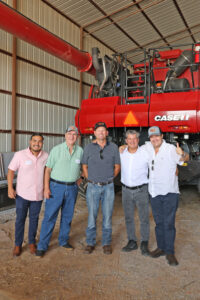
“The team was really intrigued by the scope of all they saw,” Peters said. “From the start of planting wheat, how the agronomist works with the farmer to select wheat varieties to fertilizer applications – the complete package.”
Answering questions about the U.S. grain supply, handling and export systems is a main tenet of these trade team missions. As a wheat industry leader who is familiar with the needs of overseas customers, Peters was up to the challenge.
“Michael was an extraordinary host, answering all of the questions of the Ecuadorian team,” Galdos said. “The team saw firsthand how difficult it is to be a farmer, how much depends on weather conditions and all the work U.S. farmers do to grow the best quality wheat possible for international customers.”
The sum of all the team’s experiences helped strengthen the bond between U.S. wheat producers and Ecuadorian customers, establishing new contacts and renewing familiarity with the quality, reliability and logistical advantages of U.S. wheat.
“We’re very proud of our wheat and this opportunity really emphasizes the dedication and commitment the U.S. wheat farmer puts into growing the crop,” Peters said. “You cannot put a dollar figure on the value of the personal connection you make with customers during these visits. For them to come to the United States and see farmers harvesting fields or just listening to the effort they put into growing the wheat crop is very valuable.”