
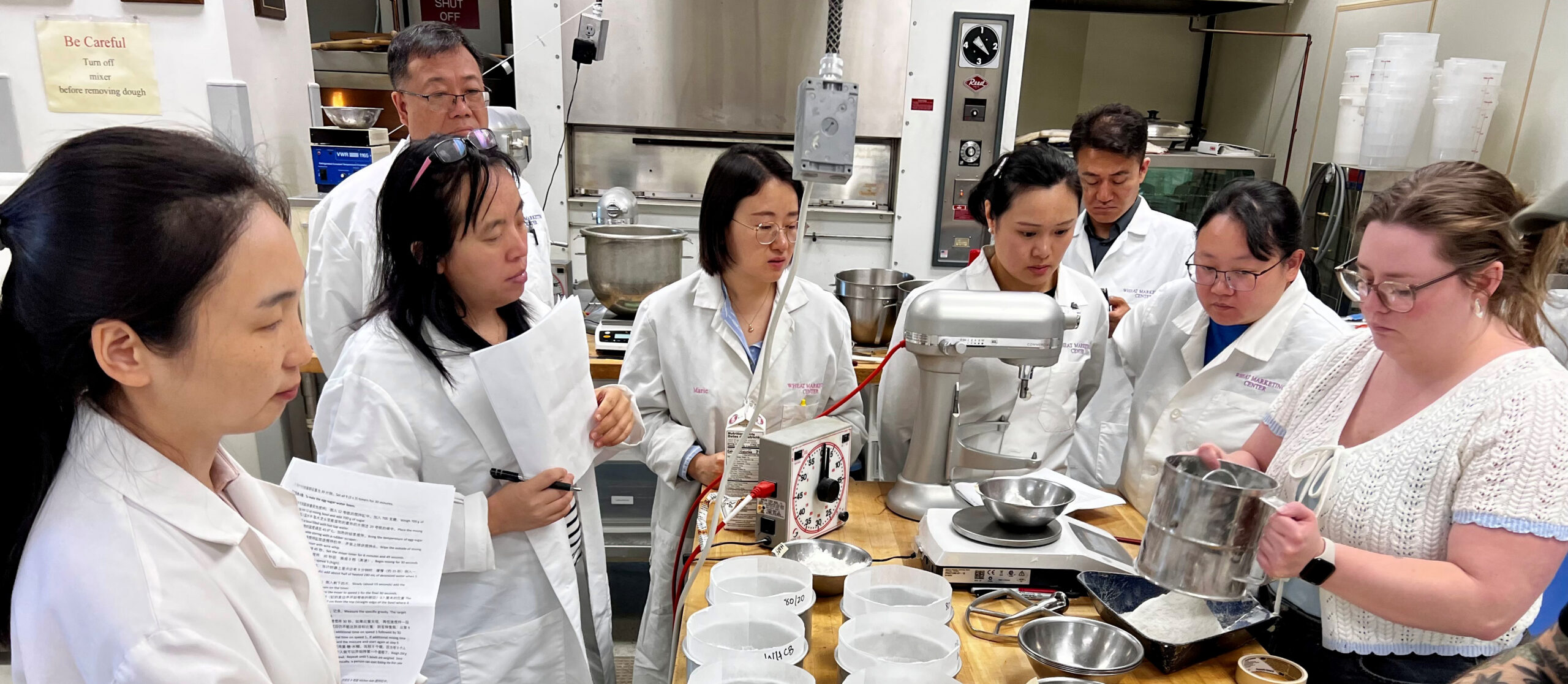
Which wheat – or blend of wheats – works best for what product? That’s the ultimate question teams come to answer during the End Product Collaborative Short Course at the Wheat Marketing Center (WMC) in Portland, Oregon. The course is designed to put different wheat blends to the test for the specific end products that international customers are considering to tweak or introduce into their business operations.
Pro-tip: the six classes of U.S. wheat rise to the top of the results across product categories, proving the quality of U.S. wheat is consistent, while blending the classes together can make the perfect formulation.
U.S. Wheat Associates (USW) recently organized a team from China to attend the WMC End Product Collaborative Short Course from June 7 to 14, 2026. The team included seven representatives from private Chinese mills and food manufacturers, whose responsibilities ranged from research and development to grain merchandising and end-product marketing.
“This EPC course supports our private customers in China in expanding their businesses by increasing the variety of bakery products that require high-quality U.S. wheat,” said Steve Wirsching, vice president and director of the USW West Coast Office, who accompanied the team in Portland. “It also provides targeted direction for developing the wheat market in China, ultimately contributing to increased imports of U.S. wheat.”
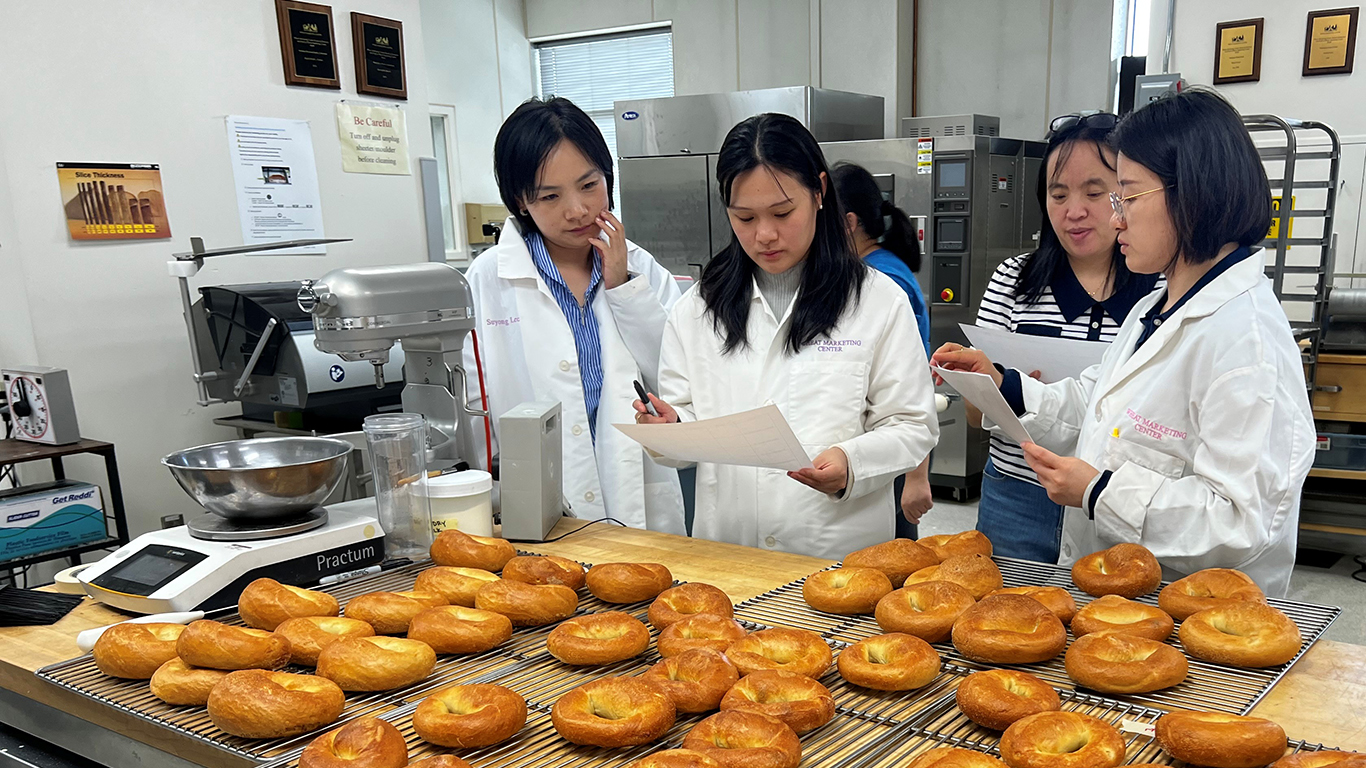
Under the direction of Dr. Jayne Bock, WMC technical director, and Dr. Andrew Mense, food scientist and public projects manager, the course focused on using U.S. wheat to produce trendy bakery products in the Chinese market. The team baked several Western-style breads, including clover dinner rolls, ciabatta, bagels, focaccia, toast bread and sponge cakes. These products are in high demand among hotels and fancy restaurants that cater to international travelers, making them a premium market segment.
The team’s main takeaway was reinforcing that each product requires a different blend of wheat, but that U.S. wheat classes rose to the top. To meet the specific preference of Chinese consumers, the team experimented with the ideal formulations of U.S. wheat classes for each product. These blends are a unique strength of the six classes of U.S. wheat that competitors like Canada and Australia cannot offer.
For example, the team determined that a blend of 70% U.S. DNS (Dark Northern Spring) and 30% hard red winter (HRW) wheat was ideal for making bagels and clover dinner roll, while ciabatta and focaccia required less DNS but more HRW to get a tender but still chewy texture. For toast, to achieve the desired chewiness for the market, the team determined that 100% DNS performed best. In contrast, a blend of club and U.S. soft white (SW) wheat performed best for producing Japanese-style sponge cakes – a popular premium product.
“The Wheat Marketing Center did an excellent job developing the products that demonstrate the versatility and functionality of wheat classes,” Wirsching said. “The team showed these Chinese participants how these Western-style products can perform in their markets and help increase consumption. These products also perform best when using high-quality U.S. wheat, reinforcing the value of U.S. wheat classes in these applications.”
While in Portland, the team also toured Dave’s Killer Bread, Marsee Baking, and Oregon State University’s Food Innovation Center, met with representatives from the U.S. wheat supply chain and visited local supermarkets. These tours and discussions complement the lab workshops by reinforcing how different classes and blends of U.S. wheat perform in commercial settings.
“Our milling customers now have a better idea on how to utilize the six classes of U.S. wheat,” said Dr. Ting Liu, technical specialist of USW Beijing Office, who accompanied the team. “Our food manufacturers also know how to better communicate with flour suppliers on their flour specification needs.”
As the team returns home to their own operations, U.S. Wheat will stay in close contact, following up with in-plant visits to provide technical assistance as the team members make the pitch for introducing new products – and for importing U.S. wheat to optimally do so.