
Sustainability and continuous improvement have always been at the heart of U.S. wheat production. And increasingly, worldwide consumers are expressing an interest in the sustainability of U.S. wheat and the industry’s commitment to the future.
That’s why, at the early November fall meeting in Albuquerque, New Mexico, the U.S. Wheat Associates (USW) board of directors approved continuous improvement goals for sustainability to guide growers’ commitment to progress.
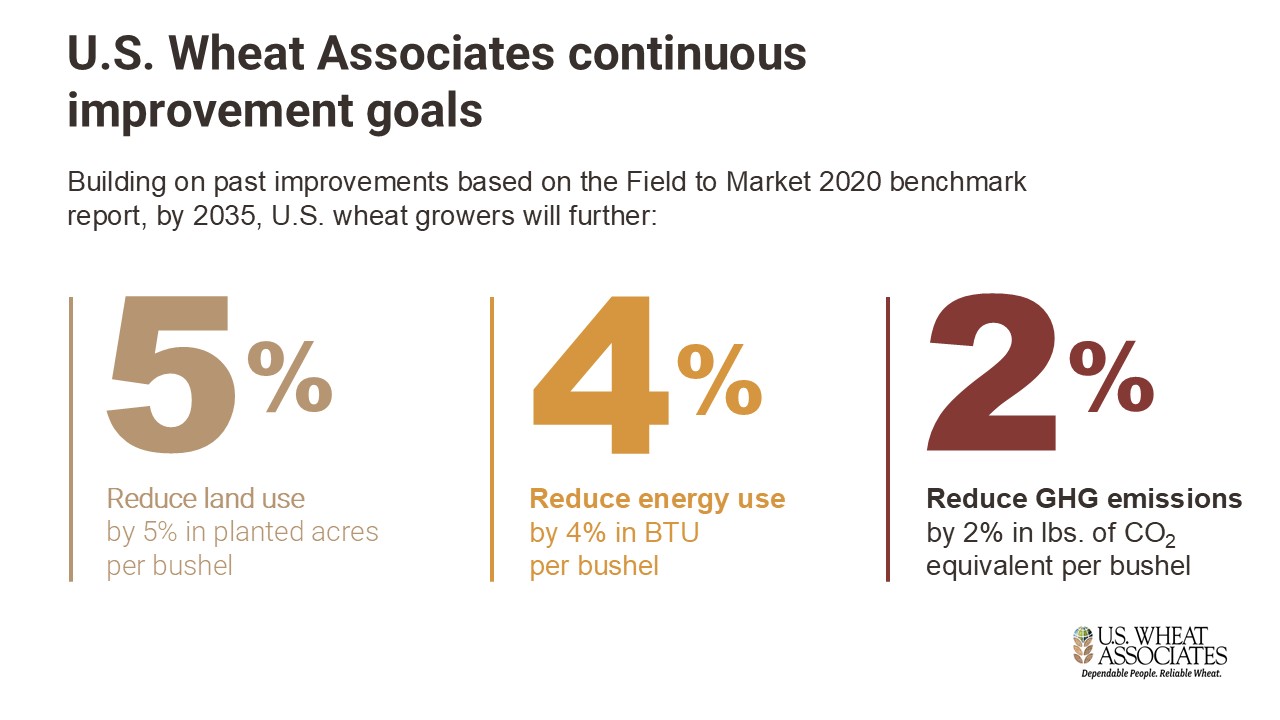
The first of their kind, these continuous improvement goals commit U.S. Wheat, by 2035, to further (1):
- Reduce Land Use by 5% (increase in bushels per planted acres)
- Reduce Energy Use by 4% (BTU per bushel)
- Reduce Greenhouse Gas (GHG) Emissions by 2% (lbs CO₂-equivalent per bushel)
These goals build on the measurable progress captured in the joint life-cycle assessment (LCA) conducted in 2024 by U.S. Wheat, the National Association of Wheat Growers (NAWG) and the National Wheat Foundation. That LCA found that U.S. wheat growers had made significant progress since 1975 on five indicators: GHG emissions, land use, energy use, soil erosion and water use.
“In developing these goals, it became clear to us that U.S. wheat farmers are proud of the progress that they have made over the decades and committed to continuing that progress into the future” said Ryan Olson, USW director of trade policy. “Our growers are optimistic about the future of U.S. wheat and about the ability of our industry to innovate and achieve these sustainability goals. U.S. Wheat is serious about sustainability and excited to engage with our customers on their sustainability journeys.”
The USW continuous improvement goals were developed over eight months by a group of U.S. wheat farmers representing a cross section of wheat producing states. Their insights into production practices and the progress that can be made, along with in-depth interviews with U.S. wheat customers on how they view sustainability, helped to cement goals that are ambitious yet achievable for the wheat farmers.
[1] Relative to a 2020 baseline based on Field to Market: The Alliance for Sustainable Agriculture, 2021. Environmental Outcomes from On-Farm Agricultural Production in the United States (Fourth Edition). ISBN: 978-0-578-33372-4