
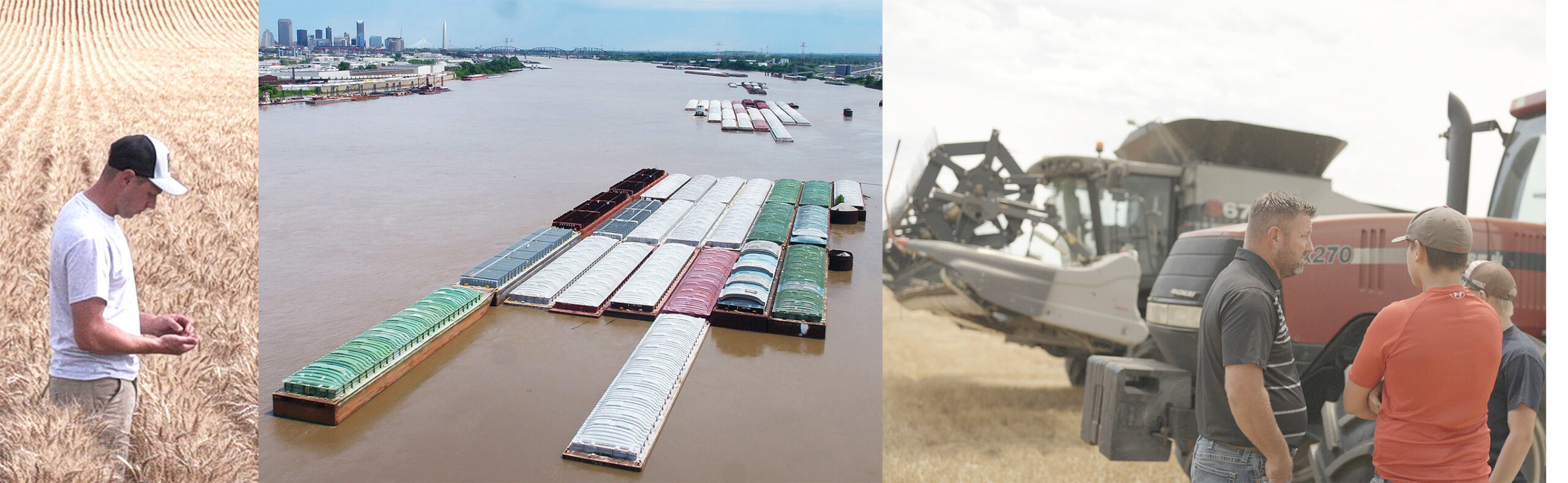
The U.S. Wheat Supply Chain Begins in the Field
The seat of a combine might seem like the most important place to be during wheat harvest. But Illinois farmer John Howell and Ohio farmer Owen Niese know that getting wheat from the field to customers around the world takes a lot more than a skilled and steady operator behind the wheel. It takes a network of people and transportation systems working together to move the crop from their farms to an international buyer.
And, as Howell and Niese explain in a new video from U.S. Wheat Associates (USW), every link in that chain plays an important role.
“It’s called a supply chain because it really takes a chain of folks to get the wheat we grow from our fields, to the grain elevator, to the river, down to the Gulf, onto a ship and then overseas to our customers,” said Howell, a sixth-generation farmer in southwestern Illinois who grows U.S. soft red winter (SRW) wheat. “The reason the U.S. wheat supply chain works is that everyone pitches in and everyone knows the importance of what we do.”
Following the River to Global Markets
From production and grain storage to barge transportation and export facilities along the Gulf Coast, the video showcases the effectiveness and efficiency of the U.S. wheat supply chain, with a particular focus on how the Mississippi and Ohio river systems help deliver SRW wheat to international customers.Funded through the USDA’s Regional Agricultural Promotion Program (RAPP), U.S. Wheat took a film crew to visit Howell during his wheat harvest in mid-June before traveling to north central Ohio in late July to spend time with Niese and his family.
The project builds on a previous USW video project highlighting the movement of hard red winter wheat from the Plains states to export facilities in Texas, primarily by truck and rail.
This time, the goal was to tell a different story – one that gives attention to the river transportation network that connects wheat producers in the Midwest with export markets around the world. The video also captures the harvest experience and the important role family members play in getting the crop out of the field.
The most effective way to tell these stories was to put Howell and Niese front and center as narrators, sharing their perspectives on farming, transportation and the importance of international markets.
A Dependable Connection to Overseas Buyers
For Howell, the connection between the farm and the global marketplace is especially important. He farms alongside his father and son, raising corn, wheat and double-crop soybeans. He understands that producing a good crop is only part of the equation. Farmers also need dependable access to markets where their SRW wheat can be used to make high-quality flour and a wide variety of food products, including crackers, cookies and cake mixes.
“The United States is poised with our river systems and barge traffic to be able to have a consistent supply of wheat to provide to global markets consistently,” Howell said. “And that’s important for a farmer like me, because it creates a consistent marketplace for me to sell my wheat.”
That reliability is a major selling point for international buyers. The ability to move large quantities of wheat efficiently by barge from the interior of the country to Gulf export terminals helps the United States maintain a dependable supply for customers overseas.
Niese offers another perspective on the journey, describing the many steps involved in moving wheat from his farm to a customer thousands of miles away.
“Once it leaves the field and gets to the local elevator, eventually it’s got to show up at a port on the river, and from there it has to travel all the way down the Mississippi River to the Gulf of Mexico,” he said.
Building Relationships Beyond the Farm
Niese also has firsthand experience with the people on the other end of that supply chain. He hosted an international trade team sponsored by USW, welcoming grain buyers and flour millers to his farm. The visit gave him an opportunity to better understand the needs of overseas customers and explain the challenges facing U.S. farmers.
“It was great because I had grain buyers, these millers here on my farm,” Niese said. “It kind of put it all together. This is where it starts at. And I get to see a face of where it ends up at, and you start talking about the different challenges they have in their countries and the challenges we have here. And it makes you thankful that we can move wheat out of our country so well.”
That personal connection is important. International customers may ultimately purchase wheat based on price, quality and performance, but the ability to understand where their wheat originates – and the people responsible for producing it — adds another dimension to the relationship.
Passing the Tradition to the Next Generation
Family is another recurring theme The next generation working alongside both farmers reinforces the importance of passing along not only farming operations but also an understanding of the broader industry that connects U.S. agriculture with the world.
For Howell, seeing his son take an active interest in the farm is among the most rewarding aspects of the business.
“It is easy to get excited about when the next generation is excited to be alongside you, when they want to spend time in the tractors, when they want to take an active role, and continuing to try to improve our operation for the next generation,” he said.
Ultimately, the journey from farm to foreign customer depends on more than the farmer who plants and harvests the crop. It takes local elevators, river terminals, barge operators, export facilities, shipping companies and countless other people working together.
As Howell and Niese demonstrate, the Mississippi and Ohio river systems provide the transportation backbone, but it is the people behind every step who make the U.S. wheat supply chain work.