
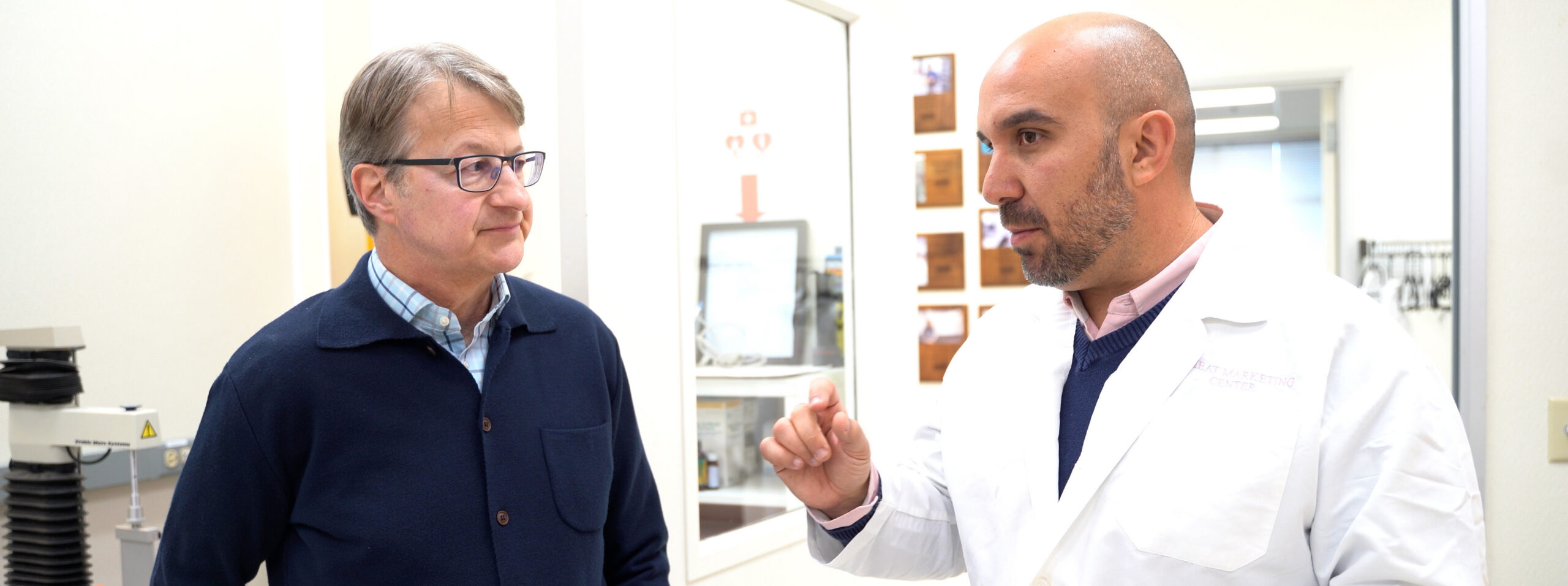

Above photo: USW Technical Manager Andres Saturno, right, with USW Vice President and West Coast Office Director Steve Wirsching.
Had his father been a soccer player, there’s a good chance Andres Saturno would today be passing and kicking and defending, instead of milling and baking and teaching.
Fortunately for customers of U.S. wheat, Saturno’s father is a professional miller – a highly respected one, at that – and the early influences of his dad’s job were subtle.
Or maybe they weren’t.
“I became familiar with flour milling when I was just a kid and my dad brought me to me to one of the mills where he was working,” said Saturno, technical manager for U.S. Wheat Associate’s (USW) South America Office in Santiago, Chile. “It was a beautiful milling facility, with trains delivering wheat and all kinds of action going on as the mill operated. The sights and sounds of wheat becoming flour really caught my attention as a young kid. The memory of those experiences is still very clear.”
Growing up in a mountain town in Venezuela, Saturno also has clear memories of the smell of fresh bread and pasta. His family’s Italian and Spanish heritage shaped the dinner table – crowded with bollitos, pan campesino and homemade gnocchi. Those aromas and tastes helped shaped his career, too, though things almost went another direction: He considered becoming chef, and he was also attracted to the mechanics of engineering.
At USW, Saturno’s role combines each of those professions.
And there’s very little kicking involved.
Using Skills, Experience
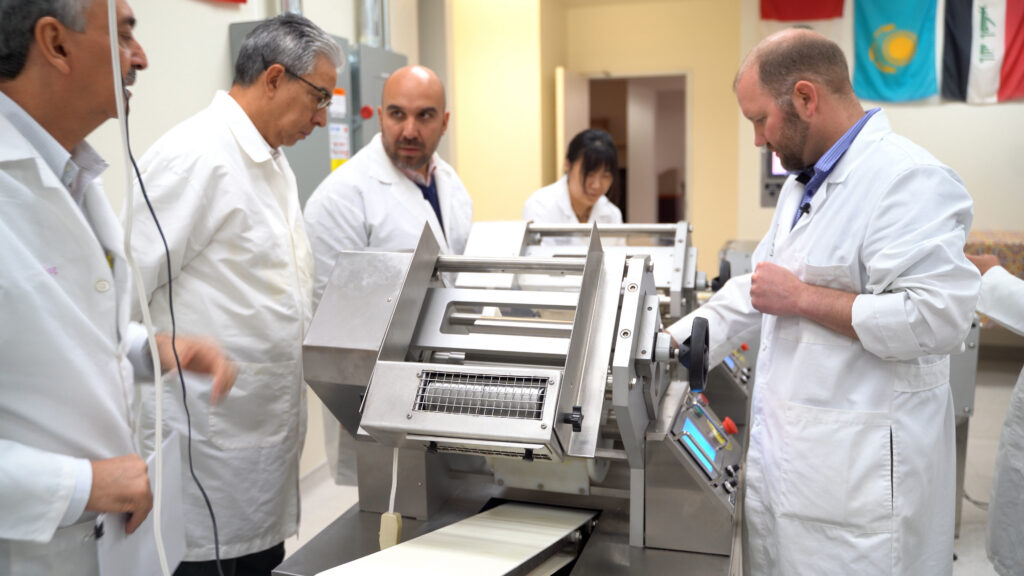
As technical manager, Saturno blends engineering, teaching and cross‑cultural communication to develop and deliver seminars, troubleshooting sessions and hands‑on training to help millers in Bolivia, Brazil, Chile, Colombia, Ecuador and Peru. The goal is to help them understand and optimize high-quality U.S. wheat.
Colleagues praise Saturno’s technical precision and his helpful approach.
In the South America region, USW’s regional baking laboratory in Santiago allows Saturno to perform advanced testing, baking trials and small‑scale milling. He helps customers evaluate wheat classes from competing global origins. Analyses at the lab guides clients in choosing the best wheat for crackers, cookies, breads and pastas.
He visits mills and bakeries in each of the six countries to help solve problems, and also leads teams of professionals on visits to the U.S. to receive technical training and learn about the different classes of U.S. wheat.
For example, in May 2025, Saturno led a team of managers from major snack food companies in Colombia to the Wheat Marketing Center in Portland, Oregon, to participate in a soft wheat workshop. The companies produce a variety of cookies, crackers and cakes in the South American market.
“The purpose was to show them the options of using either U.S. soft red winter (SRW) wheat or U.S. soft white (SW) wheats, or both,” Saturno explained. “They were not quite sure what protein level would work best for their products, so we took them to the Wheat Marketing Center for a workshop that helped demonstrate what could be done with each class. It’s important to show customers of U.S. wheat that they have options.”
Presenting and explaining those options is something Saturno enjoys.
“Every miller has different needs and different limitations, so I like looking at a problem or a challenge and helping them solve it by using the different classes of U.S. wheat,” he said.
A Unique Education
Saturno learned to bake at home, but his true education began alongside his father, the professional miller and respected industry consultant. Together, the father and son team created wheat‑flour presentations for school science fairs, comparing gluten properties and marveling at the stark difference between rice flour bread that “looked like a stone” and the “beautiful wheat flour bread” they produced.
The mills where his father worked, and the Latin American School of Milling (ESLAMO), where he served as the first director, set Saturno on his path.
“When it came time to choose a career, I really wavered between becoming a mechanical engineer or a chef,” he said. “I enrolled at Universidad Panamericana del Puerto, where I majored in milling engineering. My training deepened my understanding of baking, flour quality and pasta analysis – skills I would later use worldwide for U.S. Wheat.”
Saturno’s early career took him from Venezuela to Honduras, beginning with his first role in a durum mill attached to a pasta factory. There, he learned to mill semolina, operate mid‑century milling equipment, and eventually returned to his university to teach. Teaching, he said, was “the most beautiful job I had,” a role that connected him deeply to industry professionals.
His time in Honduras proved pivotal. As head of milling production in a new flour mill, he learned to grind SRW wheat and to develop blends tailored for tortillas and other regional staples.
A Global Role Takes Shape
In early 2018, USW began searching for a new technical specialist to support its South American regional office in Santiago. Saturno was searching for his next opportunity, and his background stood out.
“I started as a technical specialist, visiting different flour mills and baking companies, providing information and advice on how to use U.S. wheat and the flour produced with U.S. wheat,” Saturno said. “The service we provide is very valuable to customers, explain to them the six different classes of wheat grown in the U.S. and how each class can be used to produce the best flour for end products – breads, cookies, crackers and pastas.”
Saturno was eventually promoted to technical manager.
Despite his rapid rise, Saturno remains grounded in the basics. He often reminds customers that while the fundamentals of milling haven’t changed much – especially in older mills – the nature of wheat and its applications continue to evolve. His work bridges that gap, blending scientific rigor with a practical, hands‑on understanding of the craft.
Given the Choice on One Baked Good?
Outside the lab and the mills, Saturno spends much of his time with his wife and young son. His son has already visited his first flour mill – carrying forward the family tradition.
On occasion, Saturno wanders into the family’s kitchen to rekindle his love of the oven.
But he quickly concedes his wife is a superior baker, when asked a question often thrown at USW technical staff, Saturno made a point of lauding her skills.
If Saturno found himself stranded on a deserted island with a bag full of ingredients to make one baked good, what would it be?
“Well, that’s easy,” Saturno said with a chuckle. “We have a cake called tres leches that I love. It is a Latin American sponge cake soaked in a mixture of three milks resulting in a rich, pudding-like texture. It has very specific ingredients, but I would certainly choose that. The only catch is that I would prefer my wife be there to bake it – her tres leches is better than mine.”