

No matter if by truck, train or boat, the USDA’s Federal Grain Inspection Service (FGIS) inspects and grades every load of wheat exported. Staff from five flour mills in the Dominican Republic recently received a deep dive into how to best use the FGIS inspection and certification process to their advantage during a series of wheat procurement seminars organized by U.S. Wheat Associates (USW).
“USW strongly supports the U.S. grain inspection system as a competitive advantage in the world wheat market,” said Stephanie Bryant-Erdmann, USW assistant regional director for the Mexican, Central American, Caribbean and Venezuelan Region, who helped lead the seminars. “This series of workshops increases confidence in the FGIS system and provides quantifiable improvements for the participants.”
Taking a Deep Dive into FGIS Grain Inspections

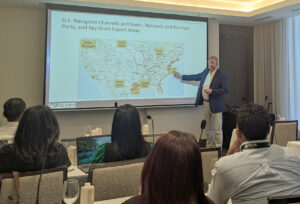
Supported by funding from USDA’s Regional Agricultural Promotion Program (RAPP), the seminars took place in Santo Domingo and Santiago from July 27 to August 2, 2025. Each seminar included a cross-section of the mill’s staff, including members from the production, purchasing, quality control and executive teams. Bryant-Erdmann was joined by Jesus Montero-Arce, a USDA-FGIS quality assurance specialist, who provided an overview of the U.S. wheat inspection system, including grading factors. Ken Eriksen, strategic advisor for Polaris Analytics and Consulting, rounded out the main speakers with a discussion of inland logistics.
More than just a series of lectures, the trio also led mill staff through a review of their current contract specifications. The group discussed how to balance price and quality, class-specific quality options and other U.S. grade and non-grade factors. Customers also identified which quality characteristics have the most value for their specific operations.
“These workshops allow mills to determine how to potentially update their purchase specifications to find savings and improve the quality of wheat they receive,” Bryant-Erdmann said. “In turn, our customers provide updated information on which quality factors are the most important for their operations.”
“We can also share an aggregated version of this information with our U.S. wheat breeders. This back-and-forth helps guide the quality targets for breeding pipelines, further improving the overall quality of the U.S. wheat crop.”
Tapping to a Nearby, Growing Market
The Dominican Republic is a significant market for these discussions as a top 15 U.S. wheat market. With no wheat grown in this Caribbean nation and close proximity to the United States, the Dominican Republic routinely imports multiple U.S. wheat classes, including U.S. hard red winter (HRW), hard red spring (HRS) and soft red winter (SRW).
In the 2024/2025 marketing year, the Dominican Republic imported nearly 525,000 metric tons (MT) (19.3 million bushels) of U.S. wheat, including all three classes and the first ever purchases of U.S. Desert Durum®. Those sales represent an almost 48% increase from the year prior. As of August 7, 2025, the USDA reported the Dominican Republic has imported nearly 115,000 MT (4.23 million bushels) of U.S. wheat in the current marketing year.
“There is an opportunity to sell additional U.S. wheat into the Dominican Republic, which is an important and growing market for U.S. farmers,” Bryant-Erdmann said. “Procurement series like these are important for building trust with customers, which helps capture those additional sales.”